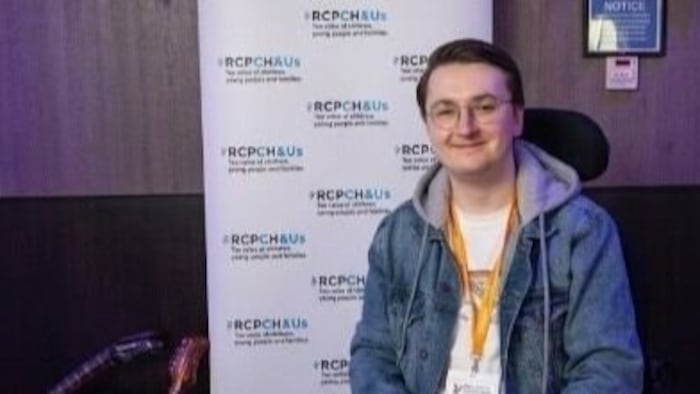
Ask anyone, and they’ll tell you that a busy bus is something to be avoided. But a couple of months ago, Jack Tolley was standing at a bus stop knowing he didn’t have a choice.
Heat and crowds trigger his epileptic seizures, but he had to get on. Why?
Because the alternative was running out of his epilepsy medication, a situation with potentially fatal consequences, meaning for Jack, the choice between getting on the bus or staying at home was life or death.
“If my friend Zoe had gotten there a few minutes later, I wouldn’t be here...”
It wasn’t always like this. When he arrived at Bournemouth University in 2024 to study cyber security, his knowledge of epilepsy was limited to “general, stereotypical stuff, what everyone knows. I thought people with epilepsy couldn’t look at flashing lights.”
But after he slipped on a patch of ice on a chilly night in December while walking home from his part-time job at a cinema, Jack learned fast.
“I take 17 tablets a day”
His slip caused a traumatic brain injury, which was followed over the course of the next few months by fainting spells, a gradual impact on his mobility, and then an epileptic seizure.
Jack began taking medication to manage the condition, but after “twenty something” hospital admissions in the year that followed his fall, it became apparent that his case was severe.
“I take 17 tablets a day now, and I’m on four different kinds of anti-epileptic medications. Phenytoin, Lacosamide, Levetiracetam and Lamotrigine. And as you can imagine, there’s a lot of side effects.”
Jack battles tremors, spasms, brain fog and short-term memory loss. In September 2025, nine months after his fall, he was put into his first coma.
When he began his recovery, Jack stayed at university. But when he was put into his second coma following another seizure in December 2025, he felt he had no other option but to end his degree and make plans to move home.
Severity
He nearly didn’t make it.
“If my friend Zoe had gotten there a few minutes later, I wouldn’t be here,” he says. “She had just arrived home from her birthday party when my app, EpiCentr, alerted her that I was having a seizure. She got to my halls in five minutes, still wearing her slippers, and performed lifesaving first aid to unblock my airway. I decided it wasn’t fair on my friends, to put all of this pressure on them to keep me alive.”
“I was down to my last tablet”
Alongside the severity of his epilepsy, national medication shortages have made it impossible for Jack to go about his daily life. A major factor in his decision to leave came after an exasperating trip to collect a repeat prescription, amid the pressure of being down to his last tablet.
“I went to my normal pharmacy one day for my repeat prescription, but they told me they didn’t have my medication. They were trying to get it, but they couldn’t tell me how long it would be.
“I had to go to that specific pharmacy three times that week just to try and get it. When they eventually released my prescription, I had to try two other pharmacies.
“Finally, Boots had it. I was down to my last tablet.”
Jack began considering which of his friends he could stay with, so he wouldn’t be alone if he had a seizure. Meanwhile, his mum, living 150 miles away in the Midlands, rang around pharmacies in Bournemouth to try and source his vital medication.
“I could only imagine how panicked she was, especially after two comas. She’d nearly lost me twice.”
While a medication shortage at a local pharmacy would be inconvenient for most, for Jack, it meant actively putting himself at risk of a seizure trying to find an alternative supply.
“There are so many kinds of seizure triggers. One of mine is being in crowded spaces and another is being hot. Just being on a bus in Bournemouth, a sunny seaside town, brings risk.”
Last line of defence
Jack isn’t the only one facing the consequences of medication shortages. Some have fared worse, as a recent coroner’s report found. Paul Nash died last October following an epileptic seizure after running out of his medication. He had missed three doses of Carbamazepine after being informed it “was not ready for collection”. Student Charlie Marriage also died in similar circumstances.
Ordinarily, Jack would visit a pharmacy every two weeks to pick up his medication, but the UK-wide shortages turned what was usually a quick trip into a regularly desperate hunt.

“Nearly every time I would struggle with one of my medications, to the point where I would have to go to a pharmacy multiple times to see if they had it, or make lots of back-and-forth phone calls.
“Most of the time, I would struggle to get Phenytoin and Lacosamide. They’re not exactly common medications and are very much a last line of defence against epilepsy.”
“What if? What if? If I…”
The stress of the constant medication shortages also began to impact other areas of Jack’s life.
“I definitely went into my shell a bit more and I didn’t go out as much. I was lucky to have friends that came to me, but if we went out, I was constantly thinking about the worst-case scenario. What if? What if? If I...”
Missing his friends made Jack’s decision to leave Bournemouth all the more painful. “I was supposed to have another two years with the friends I’d made there. They were the people in hospital with me as I was put into a coma for the first time. They were the ones who stuck by me the entire way. They were the ones who saved my life. I wouldn’t be here without them.”
Jack has since moved back home to Stourbridge, where he lives with his dad and works as a self-employed software engineer.
He is also an advocate for epilepsy awareness, working with the Royal College of Paedriatric and Child Health as part of their Epilepsy 12 advocate programme, which provides an audit of epilepsy services in the UK. “I also do a lot of work with Young Epilepsy too, helping to educate people on epilepsy because it’s such a misunderstood condition.”
“Essential”
The UK needs a “system that replaces ‘just in time’ with ‘just in case’,” says chief executive of the Epilepsy Society, Clare Pelham.
She describes epilepsy as a “cliff-edge condition” and says “missing even a single dose of medication can have life-threatening consequences. That’s why we are calling on the UK government to ensure their essential medicine supply chains are robust and resilient”.
And Jack is urging the government to “get a grip”, and has called for an increase in funding for epilepsy medication supply chains.
“There are investments that can be made to support pharmaceutical companies,” he says. “There’s such an increased demand for these medications, but there’s not the system to support that.”
“I’ll say what I always say,” he adds. “Epilepsy needs to be more understood. It’s as simple as that.”