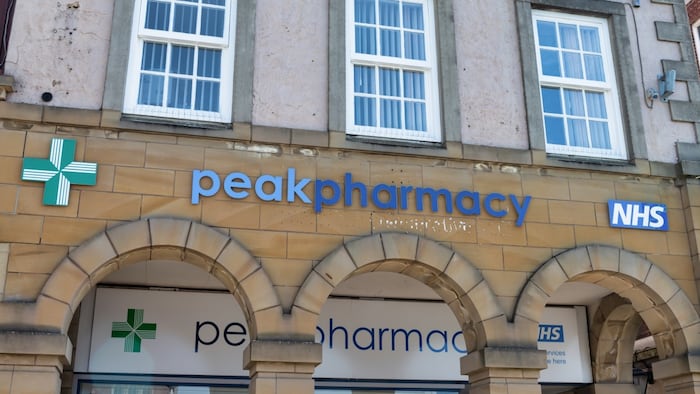
Peak Pharmacy has seen its pre-tax losses increase by some 42%, rising from £4.4 million in 2023 to £6.2m in 2024, company accounts for the year ending November 30 2024 revealed.
Published on Companies House earlier this month (August 7), the document also showed that the Derbyshire-based pharmacy chain’s turnover decreased slightly from £182m in 2023 to £178.6m last year – a 2% drop.
Read more: ‘Survival opportunity’: Peak Pharmacy reports £4.4m loss as new hub launches
In an accompanying filing for the pharmacy group’s parent company, directors said that “performance is considered satisfactory under difficult trading conditions both inside and outside the sector”.
The filing revealed that Peak Pharmacy “disposed of some outlying branches that do not feature within the strategy for the core estate” as well as “a number of properties within the estate that were previously investment purposes”.
Since November, it has “sold two pharmacies for £0.4m” and “five properties for £1.5m”, while the company “has acquired one pharmacy for £0.1m”, it said.
Read more: Peak Pharmacy secures eight-figure ‘growth’ cash injection
The rise in National Living Wage – introduced as part of the autumn budget – was “challenging”, the document highlighted, but it stressed that “the company is committed to, and has established a plan to, negate salary division among colleagues internally and within their various roles”.
In terms of workforce, the filing stated that the company has “actively been recruiting pharmacists to ensure stability across the business and currently has its lowest pharmacy vacancies rate in a number of years”.
“Large-scale automation”
Much of the parent company’s annual report also spoke about the company’s hub and spoke facility, which launched last April and is known as “Horizon”.
“We have now rolled out our automation process to all pharmacies within the estate and are seeing circa 50% of our original repeat medication prescriptions being dispensed through Horizon”, it said.
This “large-scale automation from a dedicated site will continue to transform the way that the company provides services” and offers “a fantastic opportunity to create capacity in pharmacy to support patients differently”, it stressed.
Read more: Peak Pharmacy closes Derbyshire branch as funding calls intensify
It added that this “shows a significant risk reduction in the dispensing process and a more accurate level of dispensing medication”, noting that the company is “working with a third party to ensure that purchases are monitored and that stock is not actively wasted”.
“The decrease in assembling medication at pharmacy level means that time is now available to dedicate to customer care, service delivery and development,” the document said.
But it admitted that “understandably, prescription items have taken a dip in line with expectations as a result of the processes [it has] implemented”, adding that it “has a strategy to recoup patients and improve customer service at pharmacy level going forwards”.
And it revealed that assembling and fulfilling prescriptions for “other pharmacy groups” once hub-and-spoke legislation changes come into force is also “part of the company’s ongoing strategy”.
“Disappointing but inevitable”
Peak Pharmacy managing director Joe Cattee today (August 18) said that the chain’s losses are “disappointing but inevitable”.
He told C+D that the “economic circumstances of the sector now make it virtually impossible for any of the larger family-owned pharmacy groups to invest in infrastructure and technology and trade positively”.
But he stressed that despite the losses, the pharmacy group has “successfully integrated” its new site within the planned timescales, “incorporating all branches within an eight-month period”.
Read more: Weldricks results: sales rise as disposals shore up losses slide
As well as assembling more than half of the company’s original pack medication for “next-day supply”, it assembles “in excess of 30,000 medidose trays every month” – releasing capacity in branches to “build on Pharmacy First and other services”, Cattee said.
He added that this has also “significantly reduced error rates and helped build towards a calmer, more professional atmosphere at both [the] central site and in-branch”.
“Like all larger groups we continuously review our estate and rather than fixate on turnover, we believe it is more important to develop our services in high quality, well-staffed sites wherever possible,” Cattee told C+D.
Pharmacies must “adapt”
Peak Pharmacy “welcomed” the new community pharmacy funding deal, however, as “a much-needed boost to the sector”.
The contract “shows the expectations that pharmacies will continue to promote the delivery of services”, the annual report said, noting that “pharmacy will need to continue to adapt in how it supports patients”.
Read more: Avicenna to reduce estate to 25 stores as profits rocket £8m
“It is a clear message that the government wants all pharmacies across England to offer the same experience for patients and to support them differently, freeing up capacity” for GPs and A&E, the document said, adding that this is something the company “must embrace now”.
It comes after HSBC announced in June that it had agreed an “eight-figure refinancing package” with the pharmacy chain to fund its new “automation strategy” following the development of a “state-of-the-art” warehouse.
