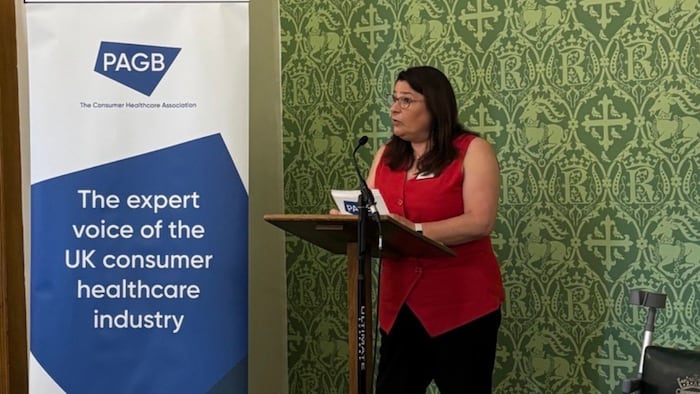
Community pharmacy should be “recognised as a core self-care partner” under the government’s 10-year health plan, the Proprietary Association of Great Britain (PAGB) announced this week.
The PAGB, which represents manufacturers of over-the-counter (OTC) medications, launched its new self-care road map on June 16, exploring how self-care can support “NHS resilience, economic growth and delivery of the government’s 10-year health plan”.
Read more: OTC branding and trust helps consumer confidence
The report noted that community pharmacy is “increasingly recognised as a partner in care closer to home”, but said “recognition is not enough”.
“To truly embed self-care in neighbourhood health delivery, policies must go beyond prioritising community pharmacy’s clinical service role and first recognise the role of pharmacy in supporting people to self-care,” it added.
And it said that to “harness the potential of community pharmacies”, the government “must go further and embed pharmacy as a named self-care partner within neighbourhood health”.
Read more: RPS supports DH move for more POM to P reclassifications
This would require giving the sector “clear referral routes, governance accountability and the resources needed to fulfil that role at scale”.
The road map also called on the government, NHS, regulators and industry to “deliberately and consistently” embed self-care in “prevention pathways, neighbourhood health, NHS productivity plans and life sciences strategy”.
Self-care should be “a strategic component of NHS reform” and the government should “establish clear leadership” for it, it added.
Reclassification
The PAGB urged the government to signpost more effectively to self-care advice, OTC treatments and community pharmacy services and ensure patients have “clear, consistent and trusted information”.
It also wants to “accelerate” prescription only medication (POM)-to-OTC reclassification, saying that a “more ambitious approach” would “expand” access to self-care and “support prevention, reduce avoidable NHS demand and unlock further economic growth”.
Read more: Fewer UK adults visiting pharmacies ‘first’ for medical advice, report reveals
And it recommended that the government work with the Medicines and Healthcare products Regulatory Agency (MHRA) to “create a regulatory environment that supports innovation”.
Savings
The PAGB cited a 2023 Frontier Economics report that found that self-care could help bring down the estimated 25 million GP appointments and five million A&E visits that are used for self-treatable conditions each year.
It added that self-care through OTCs could save up to £1.7bn annually, while cutting community prescribing costs by 5% through a “more ambitious reclassification programme” could result in over £600m in savings per year.
Read more: Two pharmacists and OTC chief recognised in King’s New Year honours list
The PAGB noted that its self-care census last year found there had been a “worrying decline in public confidence” to treat conditions by themselves.
But it said the drop “demonstrates that the barrier to self-care is not willingness, but the absence of system-level support and information needed to help people to manage their minor illnesses”.
Education on pharmacy
The PAGB also said the Department of Health and Social Care (DH) should look to work with the Department for Education so that schools can deliver the “mandated education on self-care and the role of pharmacy as set out in the 2025 Relationships, Sex and Health Education guidance”.
It called for integrated care boards to establish “clear and joined-up referral and feedback processes between community pharmacy, general practice and wider neighbourhood services”, and said the DH should “rebalance triage outcomes to support self-care with increased visibility”.
And the MHRA should create a “single market” for POM-to-OTC reclassification and consult on reforms to make injectables available over-the-counter “where clinically appropriate”, it added.
Read more: Greater use of OTC drugs could save NHS £3.1bn per year, report claims
The body also recommended that that the DH and NHS commission an evaluation of the “cashable savings of self-care and OTC usage”, and that the government appoint the Life Sciences Council to represent the OTC sector.
PAGB chief executive Michelle Riddalls said “now is the time to prioritise self-care and maximise its role in prevention, neighbourhood health delivery and productivity”.
It comes after a PAGB report found that 77% of people usually use OTCs to treat minor conditions, with men, younger adults and Black and Black British consumers more likely to buy them.