
Community Pharmacy England (CPE) “isn’t really a negotiating committee”, the National Pharmacy Association’s (NPA) chief executive Henry Gregg has said.
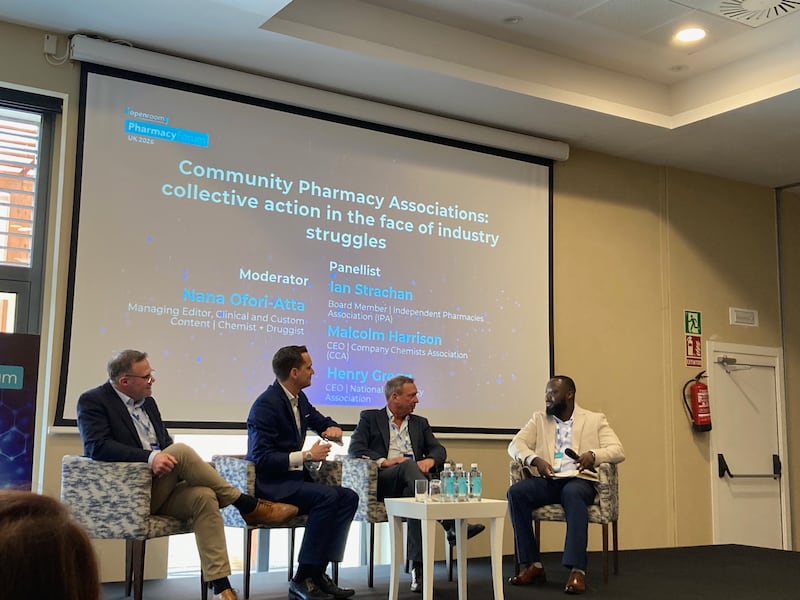
Speaking at PharmacyForum in Spain on May 18, Gregg described CPE as “a distribution committee” that decides where funding granted to the pharmacy sector will go.
Read more: CPE gave ‘abrupt’ response to call for action on contract, says IPA
This is “very important”, he added, but the negotiator is “not in a position really to go back and say we want ‘X’ amount more”.
The comments came during a panel with Company Chemists’ Association (CCA) chief executive Malcolm Harrison and Independent Pharmacies Association (IPA) board member Ian Strachan.
“Get into government earlier”
Harrison also weighed in on CPE’s limitations in influencing contract talks, saying that rather than it being a back-and-forth negotiation, the Department of Health and Social Care (DH) tells CPE what the offer is and asks “what do you want from it?”.
“There is an element to push back and push for more, and it does happen and has been successful in the past,” he said.
Read more: Over half of pharmacies could ‘limit services’ over funding gap
“But it’s not like they come along and say, ‘we’re going to give you 3%’, then [CPE replies] ‘we want 30%’, and they meet in the middle somewhere. It doesn’t quite work that way.”
Gregg told the panel that “the real decision makers are the Treasury”, and that sector bodies should “get into the government earlier, before they set the spending review”, to influence how much funding is given to community pharmacy.
“It shouldn’t be that difficult to persuade them, because pharmacy has so much to offer,” he added.
A united front?
In October, Gregg, Harrison and Strachan met with pharmacy minister Stephen Kinnock to present a “united front” ahead of the 2026/27 contract negotiations.
But when questioned on whether the bodies really are united, Gregg said he had been “quite shocked at the amount of infighting, different messages and figures” seen across the sector since he joined the NPA in May 2025.
Read more: Contract negotiations will not conclude by April 1, says CPE
“That’s the challenge for us, because if we’re giving different messages, they’ll think we can’t agree amongst ourselves,” he added. “They’re just going to ignore us.”
Responding to Gregg, Harrison emphasised that the CCA was not “counter-briefing” against the other organisations.
And Strachan said the sector needs a “better calibre of people coming into pharmacy politics” who have “conviction” - but added that it is not difficult to come together on a shared message.
Lobbying
The pharmacy figures also discussed how to lobby the government more effectively ahead of future funding settlements.
Harrison said that making “decision makers and the public aware” of what the contract needs to provide “relies on relationships with officials”.
“We need to build and leverage those relationships for the betterment of the sector,” he added.
Read more: Pharmacy retained margin funding £120m less than decade ago
And Gregg added that “finding an opportunity” and getting to “the right person, with the right idea, at the right time” is important.
He noted that in his previous role at charity Asthma + Lung UK, he saw this approach convince former prime minister Rishi Sunak - who “really hated cigarettes” - to introduce the now-enacted smoking ban for people born on or after January 1, 2009.
Read more: NPA calls for ‘emergency’ £52m payment for pharmacies
“What we need is a package that the government wants to announce, like new services for pharmacy, and have it ready to go ... when there’s an opportunity,” he said.
“It sounds mad but that’s literally how it works.”
Harrison added that “we’re all fighting over the same money, but it’s how we make sure we’re best positioned to take opportunities when they arise”.
Read more: Pharmacy chain accuses CPE of ‘ignoring’ economic review
Meanwhile, Strachan stressed that the sector’s negotiation stance should be less about “saving a penny off this, or banging on about the margin all the time”.
Instead, it must “expand” and “make an investment case” about new pathways that “would sit better in pharmacy, showing its effect on patient wellbeing, outcomes and efficiencies it could create”, he said.
“That’s what we’re missing right now.”
It comes after the IPA this month said it received a “short” and “abrupt” note from CPE declining to be involved in its call for action on the pharmacy contract.