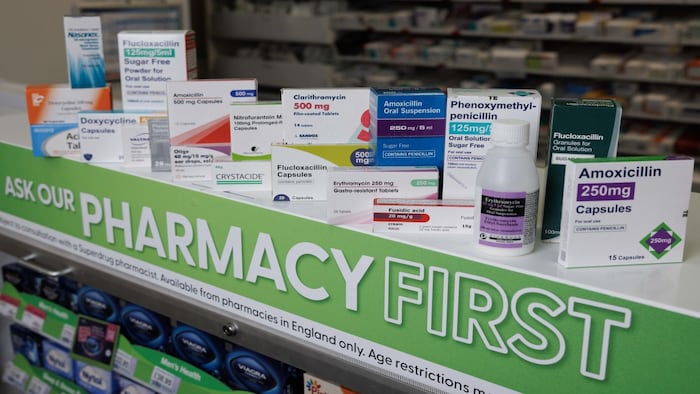
Pharmacy minister Stephen Kinnock this week (June 17) confirmed that the National Institute of Health and Care Research (NIHR) is “conducting an evaluation of Pharmacy First to assess how the service has been implemented across England”.
This will include exploring the “impacts on prescribing in the general practice setting...[and] how the service has impacted access and cost for different patient groups”, he added.
It comes after Kinnock last week said that the funding allocated to the Pharmacy First service for 2025/26 – £215m – “is expected...[to be] fully utilised” despite just £82m of the previous “up to” £645m two-year budget being used in the first eight months of 2024/25.
Read more: Just 13% of two-year Pharmacy First budget spent in 8 months
The pharmacy minister’s latest comments came in a written response to a parliamentary question from Liberal Democrat MP for Tiverton and Minehead Rachel Gilmour.
Gilmour had asked the Department of Health and Social Care (DH) whether it would assess “the effectiveness of the Pharmacy First initiative in relation to reducing the workload for GP surgeries”.
Kinnock stressed that Pharmacy First “compliments and enhances the already wide range of services offered by community pharmacy...to support patients to self-care rather than attend a GP”.
Read more: Quarter of GPs still not referring any patients to Pharmacy First
This helps to “increase access to care for patients closer to home in their communities,” he added.
The NIHR evaluation of the service – which was won in a multimillion-pound contract by the London School of Hygiene and Tropical Medicine (LSHTM) last February - is set to run for 36 months.
Among other things, it aims to “provide robust evidence to enable policymakers to determine how to enhance the role of community pharmacy in England in the future” and assess the “quality of antimicrobial use”, the LSHTM said.
“Culture change”
Kinnock also this week told MPs in a House of Commons debate that “pharmacies will play a central role in the shift from hospital to community…at the heart of our 10-year plan”, adding that the government wants “pharmacists to be taking pressure off primary care”.
“An important part of that, of course, is Pharmacy First,” he acknowledged, but stressed that “the take-up of Pharmacy First is not what we would like it to be”.
“We are looking at options to increase awareness of Pharmacy First and to free up pharmacists to be able to operate at the top of their licence,” he said.
Read more: Pharmacies may ‘stop providing’ Pharmacy First over bundling rules
The pharmacy minister told MPs that the “financial arrangements for Pharmacy First...need to be set at a level that incentivises pharmacists”.
“Sadly, given the way in which the scheme was set up under the previous government, those incentives were not working, which is one reason why the take-up of Pharmacy First has not been what it needs to be,” he added.
Read more: Pharmacy First consultation fee caps slashed £10k in six months
The DH wants to see a “culture change” regarding pharmacy, Kinnock said, adding that the “interface between general practice and community pharmacy is not where it should be”.
“We believe that pharmacists have a huge amount more to offer, but that requires a better digital interface and better information sharing—a single patient record,” he added.
Kinnock last month revealed that one in four GP practices do not refer a single patient to the Pharmacy First service each month.
