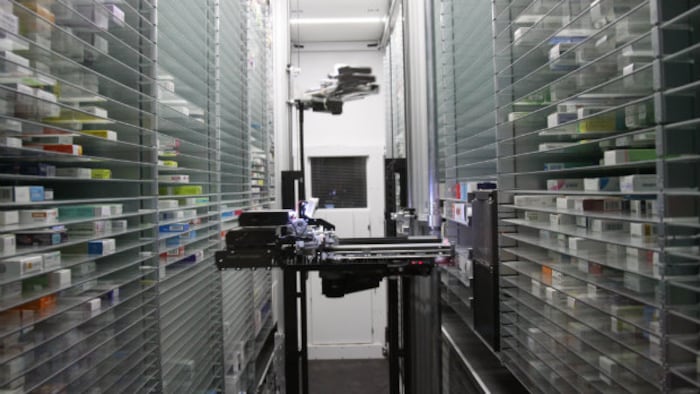
The Department of Health and Social Care (DH) today (July 3) revealed that “over the first half” of the 10-year health plan – announced today – it will “modernise” its “approach to the dispensing of medicines and make better use of technology”.
This will include the introduction of “dispensing robots” as well as “hub and spoke models” to make dispensing services “fit for the 21st century”, it said.
“By 2035, robots will deliver care with unprecedented precision,” the plan said, explaining that “pharmacy automation will ensure medication gets to patients quickly, easily and safely”.
Read more: IN FULL: Pharmacy to ‘transition’ from dispensing to clinical services by 2030
The government will “scale the use of robotics in pharmacy” under the 10-year plan, which will be used to “fill prescriptions far more quickly and accurately than humans”, it added.
“We now get many of life’s essentials delivered straight to our home - medicines should not be an exception,” it said.
And it set out that the government will “engage with the sector and the public on proposals to modernise our approach to medicine dispensing”.
Read more: DH to launch pharmacist-staffed ‘neighbourhood health services’
But the plan revealed no further details on the proposal – including how it will be funded.
Speaking about the plan in the House of Commons today, health secretary Wes Streeting stressed that pharmacies will play an “expanded role” in the new “neighbourhood health service” announced yesterday.
“They will manage long-term conditions, treat conditions like obesity and high blood pressure [and] screen for disease and vaccinate against it,” he added.
“Bigger role” for pharmacies
Streeting set out that the government aims to have “250 to 300” neighbourhood health centres open “by the end of this plan” – in 2035 – and for 40 to 50 centres to open “over the course of this parliament”.
And he estimated that “the cost of each neighbourhood health centre will vary from the low millions to around £20 million” depending on whether a building needs an “upgrade” or a “new build” is required.
Read more: Primary care leaders warn ‘little capacity’ for community care shift
The plan also revealed that the government will “transition community pharmacy from being focused largely on dispensing medicines to becoming integral to the neighbourhood health service, offering more clinical services” over the next five years.
It said that pharmacies will be given a “bigger role in prevention by expanding their role in vaccine delivery and in screening for risk of cardiovascular disease and diabetes”.
And it added that “over time”, community pharmacies will be “securely joined up to the single patient record”.
Check the C+D site for the latest on this developing story