
The Professional Standards Authority (PSA) has successfully appealed two General Pharmaceutical Council (GPhC) decisions on fitness-to-practise (FtP) cases relating to sexual misconduct in recent years, C+D can reveal.
The PSA said it had lodged an appeal against one GPhC FtP decision made in 2023/24 and one made in 2024/25 over concerns about the regulator’s findings in both cases.
Read more: GPhC receiving over 9,500 fitness-to-practise concerns in a year
It added that the number of sexual misconduct-related FtP cases heard by the GPhC has increased every year since 2022/23, with 34 heard in total over the last five years.
FtP cases relating to sexual misconduct accounted for 12% of all cases the PSA received from the GPhC in the last five years, while no such cases were heard by the Pharmaceutical Society of Northern Ireland over the same period.
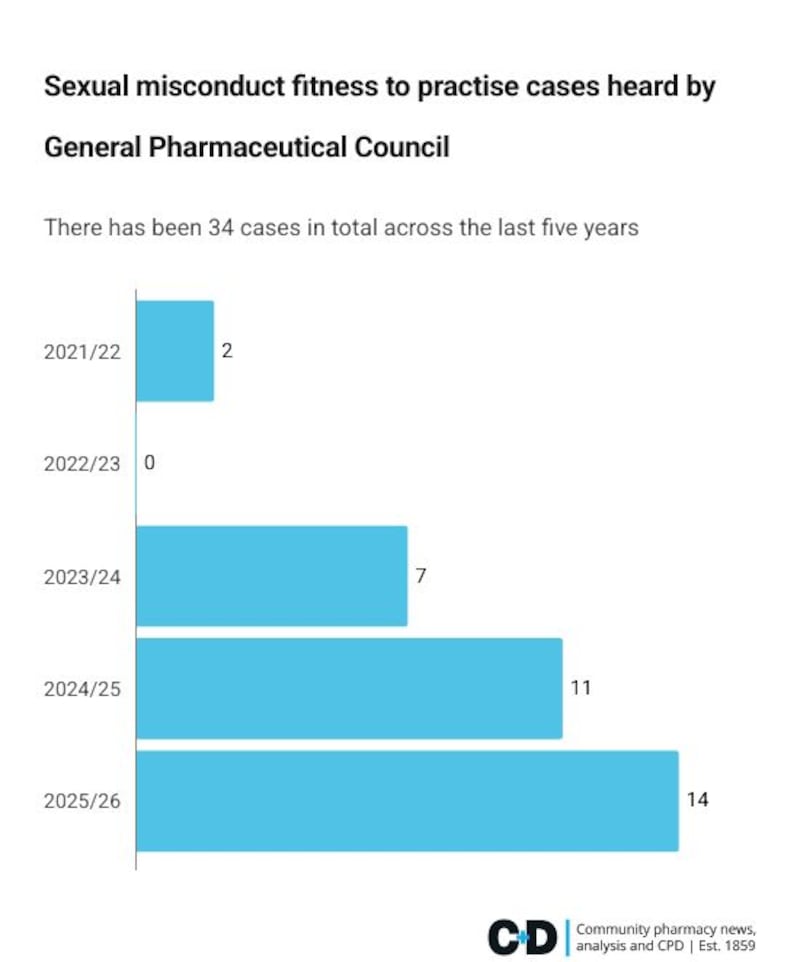
The GPhC told C+D that it takes allegations of a sexual nature “very seriously” and has “specific guidance on maintaining clear sexual boundaries”, as well as acceptance criteria published this year that sets out its “approach to concerns alleging sexual misconduct”.
The regulator said that following the “notable shift in the general reporting of allegations of sexual misconduct cases in the years following the MeToo movement”, it had introduced “several initiatives” to support those alleging sexual misconduct by a registered professional “to follow through to resolution in what can be very lengthy processes due to them often running simultaneously with criminal cases”.
“This included free access to victim support and advocacy services to support them at the hearing if needed,” it said.
“No case to answer”
One of the PSA’s appeals was against the GPhC’s decision in a case involving pharmacist Azhar Ali Ahmed, in which the regulator had found “no case to answer” following allegations that Ahmed “touched a male colleague’s genitals” - despite his own admissions.
The PSA said it appealed because the GPhC “did not make adequate efforts to secure the colleague’s attendance at the hearing” and the panel was “wrong not to take account of the colleague’s hearsay evidence”.
Read more: Revealed: What complaints did the GPhC face in 2024/25?
It added that the GPhC did “not provide an adequate basis for the panel to determine the application of no case to answer”.
The appeal was upheld by the High Court in December 2024 and the original decision was “quashed and remitted back to a new panel”, the PSA said.
Ahmed has since been removed from the GPhC register.
Inappropriate examination
The PSA’s other appeal involved pharmacist Muhammad Farooq, who received a six-month suspension with no review after he was found to have performed an “internal vaginal examination” on a patient, despite it being “neither clinically justified” nor he “qualified [or] competent to do so”.
The PSA said it appealed the GPhC’s decision as it was concerned that the panel’s approach and finding that the examination was not sexually motivated was wrong.
Read more: Weight loss jabs: Almost 750 GPhC concerns raised this year
It added that a previous incident involving the pharmacist was not considered by the regulator, and that it was concerned that the charges heard by the panel did not address Farooq continuing examination despite the patient expressing that she was in pain.
The High Court upheld the PSA’s appeal in April 2024, ruling that the GPhC’s decision was “quashed” and a new panel should hear the case. The GPhC was also told to pay the PSA £7,200 in costs.
C+D has approached the GPhC for comment on the status of Farooq’s fitness to practise.
More appeals
The share of sexual misconduct FtPs that the PSA has appealed against for the 10 regulators it oversees has increased from 11% in 2021/22 to 26% in 2025/26, according to a report published by the body on September 8.
It said there has been an increase in its appeals against sexual misconduct-related FtPs because the decisions made by regulators were “insufficient for public protection and public confidence in regulation”.
It added that some FtP decisions “lack clear, structured reasoning tying findings to each charge”, and do not fully articulate “why misconduct is or is not considered impairment, and why a given sanction is warranted and others are not”.
Read more: GPhC whistleblower disclosures rocket up 208% in a year
Some decisions also “fail to consider the allegations holistically”, as the “combined impact of the allegations may be greater than the sum of the individual parts”, it said.
The report also found that the number of sexual misconduct-related FtP cases the UK’s PSA receives has increased from 115 in 2021/22 to 224 in 2025/26, and now accounts for 16.6% of all cases.
The PSA said it was “not possible to say definitively what is behind this increase over time”, but that there could be “greater awareness of unacceptable conduct” and an “increased confidence in reporting”.
Read more: GPhC told to speed up processing FTP cases in latest annual report
It noted that there may be “stronger regulatory and employer responses” in relation to harassment towards colleagues, and “evolving case law and guidance” around sexual misconduct.
But it added that the rise in cases may also reflect a “possible increasing prevalence of this kind of misconduct”.
Struck off
The PSA’s report draws on its reviews of final FtP panel decisions and found that 70% of sexual misconduct cases across all regulators in the last five years resulted in the registrants being suspended or struck off, with the latter the “most common outcome”.
There has also been a decrease in findings of no impairment or no misconduct in cases concerning sexual misconduct, down from 16.5% of cases in 2021/22 to 8.5% in 2025/26.
PSA regulation and accreditation head Graham Mockler said the report collates “learning and insights we have developed through our oversight work, engagement with experts and discussions with stakeholders”.
Read more: GPhC to be given power to decide FtP cases without hearing
“Fair, sensitive and effective handling of these cases is essential to maintaining public confidence and protecting patients, service-users and the wider public,” he said.
It comes after the GPhC revealed in May that it is now receiving more than 9,500 FtP concerns in a year.