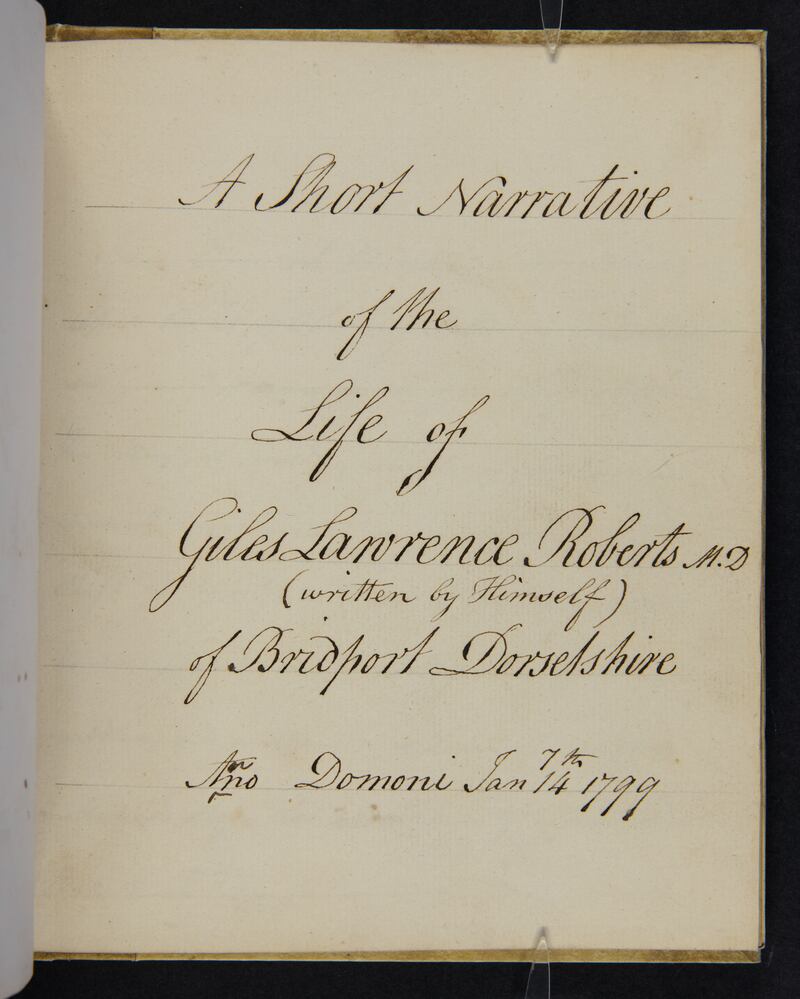
Dr Giles Roberts wrote the autobiographical ‘Short Narrative of the Life of Giles Lawrence Roberts M.D’ a year after he invented the infamous Poor Man’s Friend ointment in 1799.
Dorset History Centre, in partnership with Bridport Museum, has bought the text from London’s Forum Auctions for £926.
The manuscript explores Roberts’ early life, scientific interests, and “strong religious convictions”, and Dorset History Centre services manager Sam Johnston said it’s a “remarkable piece of Dorset’s history”.
Read more: Pharmacy in the 17th century: a look inside an apothecary’s shop
“It provides a first-hand account of the life and work of Dr Giles Roberts, whose contributions to medicine and the local community were significant. We’re thrilled to make this resource available for future generations,” he said.
It was funded by a grant from charity Friends of the Nations’ Libraries, and it will be preserved at Dorset History Centre for public access and research, as well as being made available for exhibition at Bridport Museum in the future.
Who is Roberts?
Bridport Museum have a display on Roberts, and the manuscript is helping them understand his early life and influences.
A digital copy of the manuscript will be supplied to Bridport Museum for volunteers to work on, and the museum is looking for volunteers to help with transcribing and digitising his diaries.
Roberts was born in 1766 and had smallpox and rickets as a child. He was interested in mechanics, philosophy, chemistry, electricity and magnetism.
Read more: Exploring pharmacy museums around the world
Roberts started working as a chemist at the age of 18 in the town. He studied a book by renowned herbalist Nicholas Culpeper and became interested in making medicines using plants.
As his business became popular, he sold “pure and cheap” medicines and claimed these could cure “many ailments”. Roberts was trusted by his patients and the Bridport public raised money to send him to study in London in 1794.
He was licensed to act as an apothecary, surgeon and accoucheur (someone who assists at childbirth).
Poisonous ointment
Roberts claims his Poor Man’s Friend ointment could cure “aches, pains, gout, wounds, burns, chilblains and sore and inflamed eyes”.
It brought the apothecary success and wealth through word-of-mouth recommendations and local papers advertising it, and it was the “second-best selling patent medicine in Britain” by the early 1800s and found as far away as Australia.
Poor Man’s Friend was still made well into the 20th century, and the “secret” recipe was found by a pharmacist who bought Roberts’ original shop in the 1970s.
Read more: ‘Oldest pharmacy in world’ opens in Harrods
The museum note Poor Man’s Friend would have made a “pleasant perfume”, but “it would have been poisonous”.
The ointment mostly contained lard and beeswax, but it also included small amounts of lead sugar, mercury salts and calomel that could have resulted in “arm and facial tremors, inflamed gums, loose teeth, upset stomach, jerky movements, and personality changes”.
But patients trusted Roberts and still took the ointment. In 1807, Roberts was appointed medical attendant to the poor in Bridport and campaigned for better hygiene. He provided weekly free consultations to the poor and offered free meals.
Read more: ‘I won’t miss the dusting!’ Pharmacy artefacts sold for thousands of pounds
He also used electricity through the magnetic electrical machine as treatment for headaches and toothaches, and even “cured a man who had become dumb” by sending electric shocks to his neck.
Roberts was religious and he even obtained a licence to preach, as he delivered over 120 sermons across the West Country.
Roberts collected unique items that he had on display in his house that visitors came to see. It included the human skulls of New Zealand tribal chiefs, a whale or mammoth bone, a large glass case containing a penguin and a variety of small, rare birds.
Read more: Theme park’s £20k Victorian pharmacy set for auction
He died at the age of 68 which was very old for the Georgian era. Roberts left his business to two of his apprentices as his wife died before him and he had no surviving children, and he also gave several houses to the Wesleyan Methodists.
It comes as “the oldest pharmacy in the world” has opened a new premises in London’s luxury department store Harrods.