The year is 2050 and your regular patient comes into the pharmacy. It is business as usual: he smiles and places his thumb on the scanner, which informs him there will be an estimated waiting time of 15 minutes for his 3D-printed medicine. You check the PMR to make sure the prescription is appropriate for his genetic signature and, all being in order, you select ‘print’. While he is waiting, you give him a microneedle patch that will deliver a dose of the flu vaccine and ask whether he would like his personalised medicine on repeat prescription.
This may sound like a far-fetched scenario. After all, medicine development has largely been a case of ‘evolution’ rather than ‘revolution’ over the past few decades – with few discoveries that could truly be hailed as game-changers. But pharmaceutical experts forecast that 3D printing, microneedles and personalised medicines will soon become a reality of pharmacy practice. They reveal what to expect from the next generation of medicines.
3D medicine printing
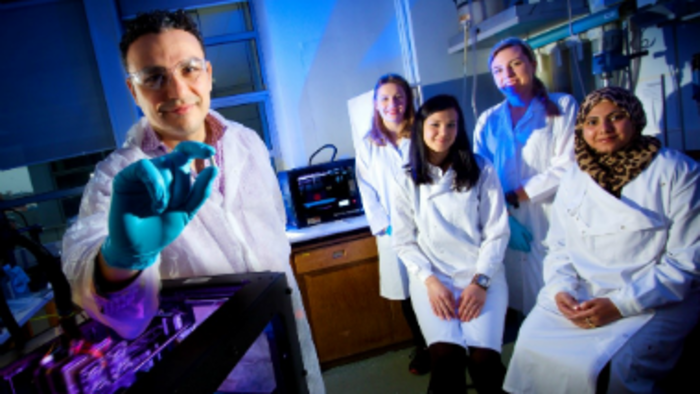
As every pharmacist knows, not all patients can tolerate standard medicine doses. But what if you no longer had to ring up a specials manufacturer for a tailored dose, and could print it in your pharmacy instead? The dream may soon become a reality, if work by Mohamed Albed Alhnan, lecturer in pharmaceutics at the University of Central Lancashire, goes to plan. Dr Alhnan and his team are working to make 3D printing the next major development in medicine.
He says 3D printing of drugs is “not far away from” the clinical trial phase and expects printers to hit the market within the “next few years”. Dr Alhnan says the technology should be particularly useful in the case of drugs with a narrow therapeutic range. Medicines could be printed to the exact dose that suits the patient and those who need to change their dose regularly can do so “quickly and in a seamless way”. Having medicines that are “engineered for their particular case” will increase adherence, he believes.
The goal will be to make 3D medicines as “similar-looking” as regular medication to avoid any confusion. Every effort will be made to ensure it is “very user-friendly” for pharmacists too, Dr Alhnan stresses. For those who are worried about having yet another piece of technology liable to go wrong, he explains that the “major responsibility” for the 3D printer will lie with the manufacturer.
The microneedle patch
A patch containing hundreds or thousands of needles sounds like every injection-phobe’s worst nightmare. But a microneedle patch can be applied to the skin “painlessly and without drawing blood”, explains Ryan Donnelly, professor and chair in pharmaceutical technology at Queen’s University Belfast. He and his team are at the forefront of developing these patches, which deliver therapies by gently puncturing the outer barrier of the skin.
The technology could have far-reaching uses. The microneedle method has “opened up” the small selection of medicines available through transdermal delivery to include a far vaster range, including biological therapies such as insulin, antibody therapy and vaccines, explains Professor Donnelly. The patches could also be a potentially non-invasive way to capture tissue fluid for “monitoring or diagnostic purposes”, eliminating the need for blood samples.
Professor Donnelly believes this technology will have a number of benefits. Firstly, patients will be able to administer therapies, such as vaccines, themselves – freeing up the time of healthcare professionals. Secondly, the patches have the potential to “play a role in vaccine delivery in the developing world”. Incorrect storage of vaccines leads to a high level of wastage in these countries – a problem that patches could solve. Unlike vaccine vials, patches do not need to be refrigerated and do not need a power source to be kept in condition, Professor Donnelly explains.
Thirdly, he believes patches will diminish the need for top-up vaccinations. Because patches will deliver the drug to the antigen-presenting cells in the skin – rather than intramuscularly or into the subcutaneous fat – they will create a greater immune response than injections. Professor Donnelly says this means “you could probably vaccinate people with a single dose”.
There is one concern over microneedles: that they could be reused. It is easy to see how this could spread disease or result in subtherapeutic doses of treatment. But Professor Donnelly explains that the microneedles produced by his department at Queen’s University are unique in that they are made from a polymer.
Unlike metal or silicon, this material does not have the potential for reapplication. Instead, once the patch is used the polymer will “swell to form a soft contact lens-type jelly material after one minute”, rendering it unusable.
It sounds as if the technology has been well thought through. So when can we expect to see the patches arrive on the market? Professor Donnelly believes we will see microneedle technology become a reality “within the next two years” – initially for cosmetic treatments, such as reducing the appearance of wrinkles or blemishes. A drug delivery product may take longer due to the tight regulations involved; he expects a wait of around five years.
When the products do finally launch, Professor Donnelly says the role of the pharmacist will be “really critical”. His team has made the patches as user-friendly as possible – creating a backing layer that will change colour when the correct force is applied – but he believes pharmacists will still need to counsel patients to ensure this new method of drug delivery is used correctly.
Personalised medicine
In the world of healthcare, personalised medicine has become a hot topic. Experts have jumped on the idea of tailoring medicines to an individual’s genes and specific needs with enthusiasm. Indeed, NHS England’s national medical director Sir Bruce Keogh called for the “accelerated” adoption of personalised medicines last year, setting out a goal for the NHS to become “one of the most advanced healthcare systems in the world” in this field.
The perceived benefits sound very impressive: more effective treatment with fewer side effects. But David Taylor, professor emeritus of pharmaceutical and public health policy at University College London, is somewhat sceptical.
There will be no “overnight revolution” that gives everyone access to their own tailored medicine, he argues. In fact, he believes there is little need to go down this path – “the idea that each person will be different is probably non-viable”. Instead, Professor Taylor says that a medicine tailored to a particular person will only be developed under exceptional circumstances. And the idea that there will be no side effects of these medicines is, to him, “moonshine”. In fact, he says there is “nothing terribly new” about the concept of personalised medicine. He stresses that the purpose of healthcare has always been “to be as personally relevant as possible”. So for him, personalised medicine is simply “building on” the existing work to shape care to individual needs.
The future may well hail the development of more medicines to cater for different genetic groups, though, and he sees clear opportunities for pharmacists in this field. Professor Taylor believes they will play a role in genetic testing, which will allow for more “exact diagnoses”.
To do so, pharmacists will need a change in technology – Professor Taylor believes access to patient records is a must – and a change of mindset.
As he explains, the profession will need to think more about the patients they treat: “Pharmacists in the past have been experts in medicines, but now they need to be the experts on the people who use medicines.”
Read more about the future of medicine:
Brainbox - what are the implications of prescribing modafinil?
How do you think developments in medicine will affect pharmacy?
We want to hear your views, but please express them in the spirit of a constructive, professional debate. For more information about what this means, please click here to see our community principles and information