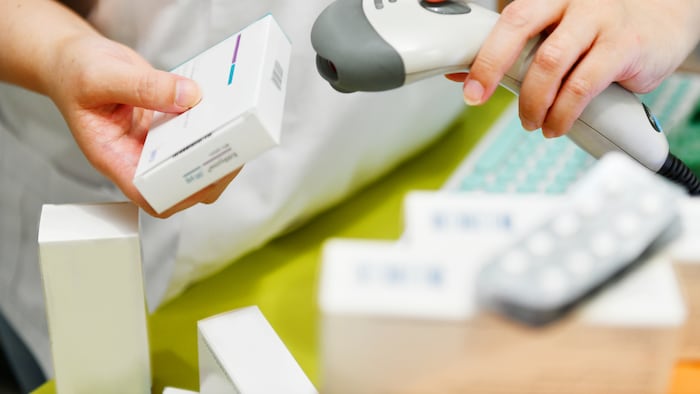
Pharmacists who have adopted the newer “scan-to-label” workflow know the reassuring ‘beep’ when a medicine pack is scanned.
It’s the sound of safety , confirmation that what we are handing a patient matches what was prescribed.
This way of working was pioneered by Titan PMR, and has since been adopted by other systems such as Columbus (Boots) and RxWeb over the past year. It has helped bring barcode scanning into everyday dispensing, improving accuracy checks and stock control without adding friction to the workflow.
Yet behind that simple scan lies a flaw that many of us face daily: barcodes that are wrong, missing, or duplicated , and in some cases, packs that arrive without any barcode at all.
When that happens, the confidence that scanning should bring turns into hesitation. Pharmacists must stop, check manually, override the system, or print a temporary barcode at goods-in just to keep the process moving. It adds time, frustration, and risk , all avoidable if the data were right at source.
Errors
The NHS Business Services Authority maintains the Dictionary of Medicines and Devices (DMD), a national gem updated weekly and freely available for all healthcare professionals. Huge effort goes into keeping it clinically sound and consistent.
Barcodes for individual medicine packs (known as AMPPs) are included in the DMD as a “supply-chain attribute”. The issue is that GTINs are not part of the MHRA licensing record, so the DMD team must rely on voluntary submissions from suppliers. There is no legal duty for accuracy.
The result is predictable: missing GTINs, reused numbers, and errors that spread across pharmacy and hospital systems nationwide.
Some licensed packs reach the market without any barcode at all. Pharmacies and hospitals then need to apply their own internal labels , an unnecessary workaround in a system built for automation.
Frustration
The phrase Falsified Medicines Directive (FMD) still brings memories of frustration for many.
When it was introduced under EU law, most pharmacies were not yet scanning to dispense, so the process added a step that felt bureaucratic rather than beneficial. With Brexit, that requirement was dropped, to the relief of many teams.
Read more: Countdown begins to place barcode scanners in all pharmacies
But FMD did bring one valuable outcome - the 2D barcode. Unlike simple linear barcodes, these carried the GTIN, batch number, expiry date, and serial number, making every pack uniquely identifiable.
While the falsified-medicine verification element may have been cumbersome, the unique GTIN and expiry data were genuinely useful.
They made it possible to scan a pack and instantly check what it is and whether it is still in date , something that supports both safety and efficiency.
Read more: Manufacturers may scrap low-margin products to cover EU barcode costs
Since the Windsor Framework, however, we have seen 2D barcodes quietly disappear from packs in England. Just as our systems have caught up and are ready to make full use of them, we are losing them again.
Safer
Today, the vast majority of modern PMRs , following Titan’s lead and now mirrored by Columbus, RxWeb and others, already support scanning to print labels and check expiry dates.
For those pharmacies that have embraced this workflow, barcode accuracy is not a theoretical issue but a daily operational one.
Technology is no longer the barrier. The barrier is data quality. When barcodes are inconsistent or missing, the benefits of these modern systems are lost. Pharmacists go back to manual checks and handwritten notes. Safe, yes, but time-consuming and error-prone.
Read more: Pharmacies to receive electronic prison prescriptions from next month
Accurate GTINs and 2D barcodes would not add new steps but remove unnecessary ones. They would make dispensing safer, faster and more reliable for teams already under pressure.
Impact
The solution is simple and achievable.
The MHRA should make accurate GTIN barcodes a mandatory part of the marketing-authorisation file. If a barcode is wrong, it should be treated as a labelling error, subject to correction and, where necessary, recall.
This small change would have a large impact.
It would remove countless hours of manual checking, prevent dispensing errors, and give the NHS DMD team the authority and data they need to maintain a truly complete and accurate national record.
Pharmacists are the final safeguard in patient safety and the first to spot when something isn’t right upstream. Barcode accuracy may sound technical, but its consequences are deeply human.
Every mismatch means another pause, another double-check, another moment of uncertainty in the dispensary.
That is why we have launched a UK Parliament petition calling for accurate GTIN barcodes to become mandatory on all medicines.
If you’ve ever had to override a scan, hand-write a label, or explain to a patient why their pack looks different but ‘is the same medicine’, you already know why this matters. You can learn more and see examples of the issue at barcode.pillsorted.com
Please take a minute to add your name and share it with your colleagues.
Together, we can help fix this simple but vital piece of the patient-safety puzzle. Sign the petition: petition.parliament.uk/petitions/738982
Zeinab Ardeshir is superintendent pharmacist and co-founder of PillSorted