
The number of people accessing the services of the UK’s first safer drug consumption facility (SDCF) has been “exceptional”, C+D has learned.
‘The Thistle’ opened in Glasgow in January 2025 to allow people who inject drugs to do so “under clinical supervision”.
New data revealed the service has been accessed 21,171 times, with 781 unique users attending, broken down to 609 men and 172 women.
Read more: Develop safe drug consumption access, says Scottish government
One of the facility’s partners, Glasgow City Health and Social Care Partnership (HSCP), said that while it was “anticipated that footfall to the Thistle would increase as the service established itself, the number of people accessing the services available has been exceptional”.
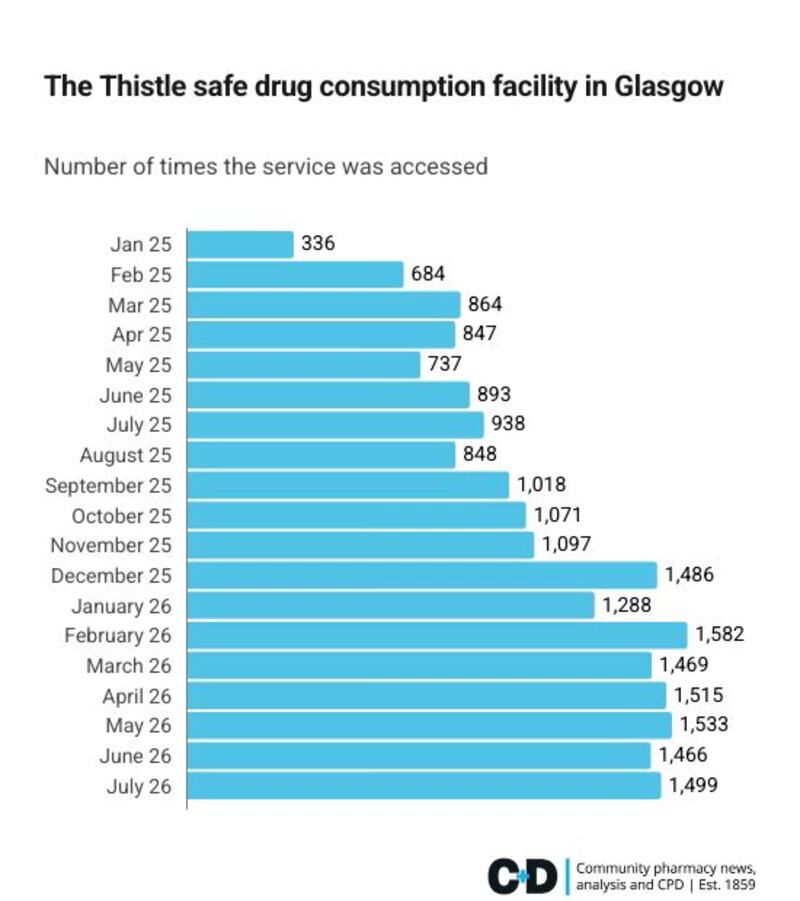
The service was accessed over 1,000 times for the first time in September 2025 and has consistently been accessed over 1,400 times every month since December, excluding January when it dipped to 1,288 times.
“The drug market changes rapidly and staff continue to monitor and feedback on trends and developments,” it added.
“Delighted”
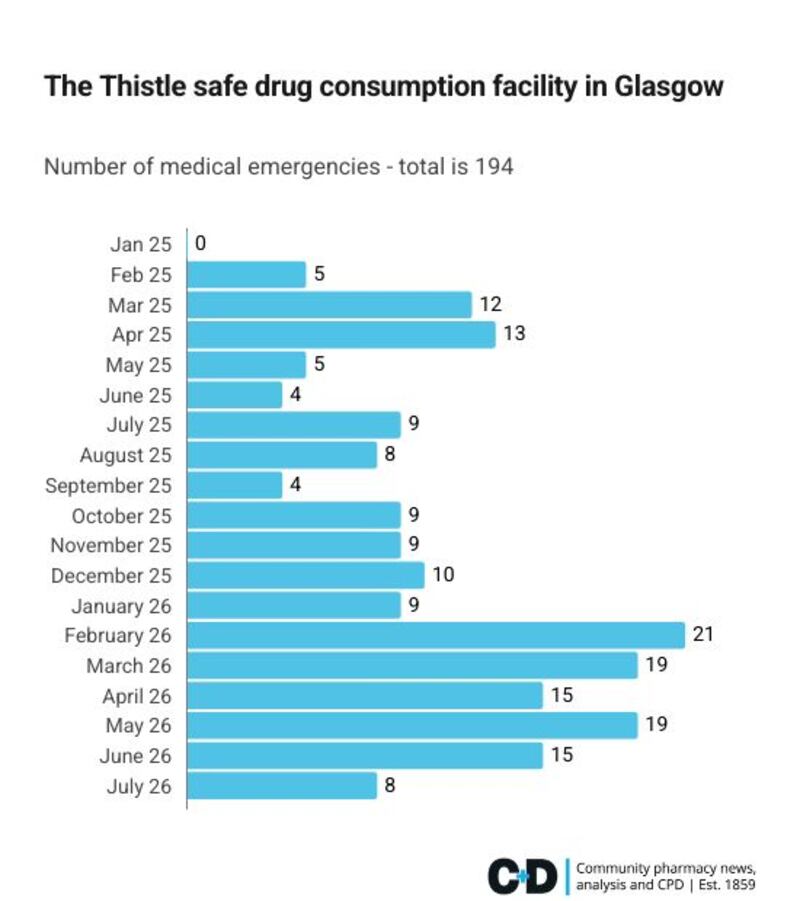
Glasgow City HSCP said it was “delighted with the work going on in the Thistle” and highlighted the “early indications of medical emergencies reducing pressure on frontline services as well preventing a number of overdose fatalities”.
Medical emergencies include when a staff member had to intervene through an “enhanced observation of the service user to administration of oxygen, naloxone or resuscitation” after the user self-administered the drugs.
Read more: Thousands use cocaine and heroin in the UK’s first safe drug consumption room
The number of medical emergencies peaked at 21 in a month in February but averaged out at just over 10 a month since the SDCF opened.
The percentage of medical emergencies in the number of times the service was accessed per month has never reached above 1.5%.
More heroine, less cocaine
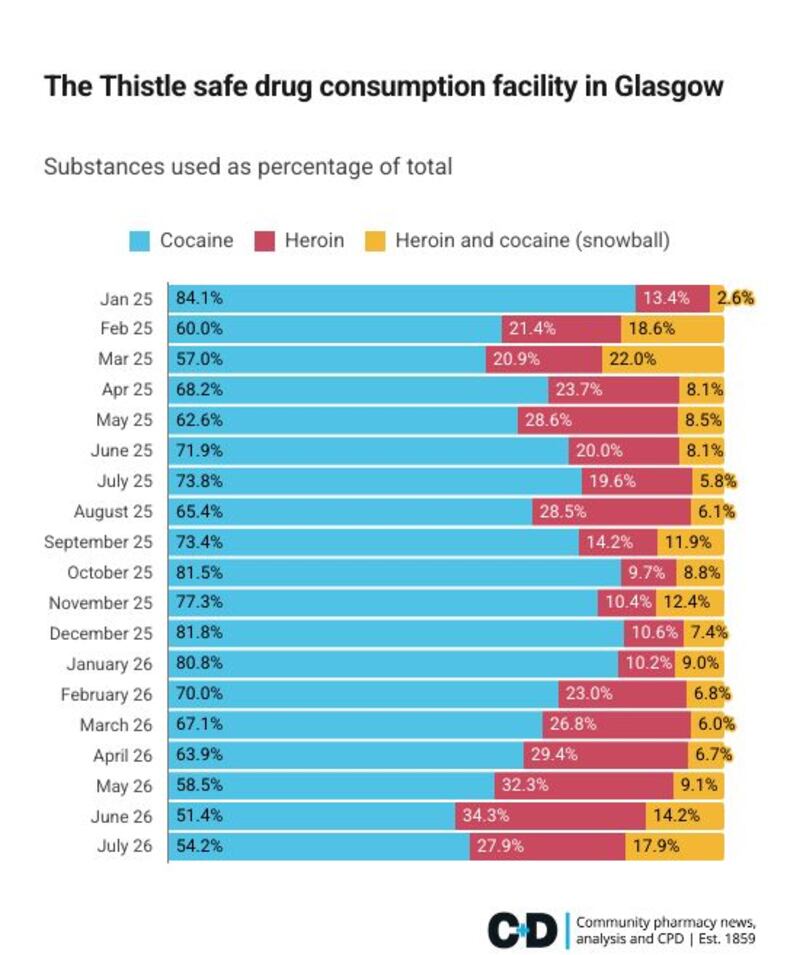
The new data revealed increasing heroin use, while cocaine use has fallen.
Since January 2026, cocaine has accounted for a decreasing number of the substances used at the SDCF, going from 80.8% to 54.2% in July.
Read more: Pharmacists involved in London’s first drug checking service
But there has been an increasing amount of heroin use in the same period, rising from 10.2% to its record high of 34.3% in June.
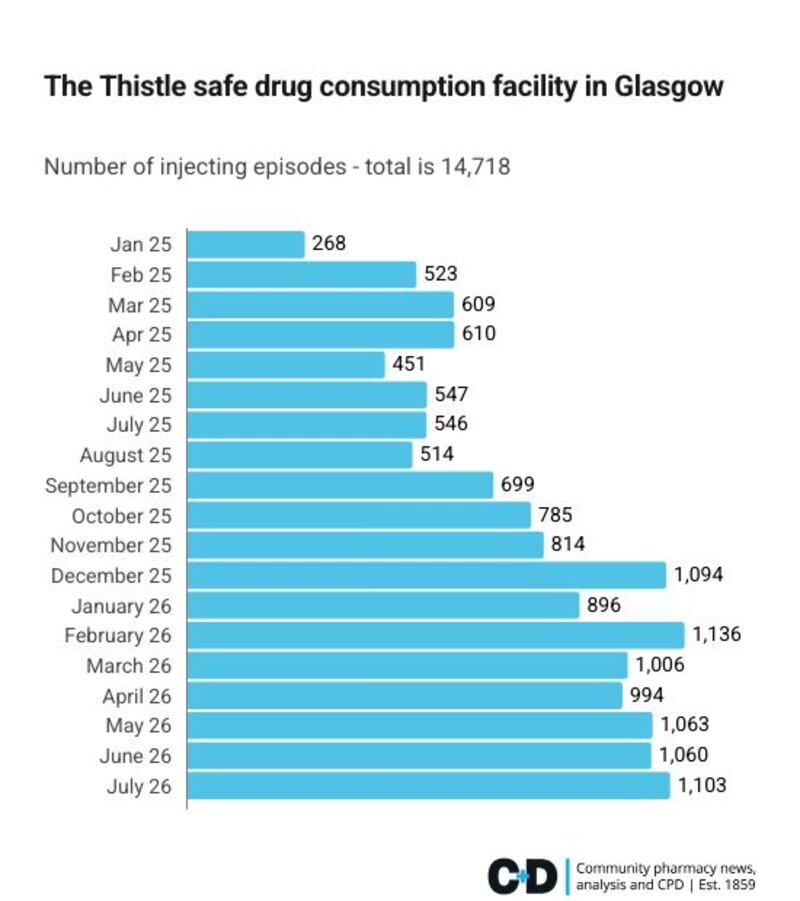
The number of injecting episodes has increased in similar trends to the times the service has been accessed, with the number around the 1,000 mark since December.
Edinburgh
It comes as the Edinburgh Health and Social Care Partnership (EHSCP) considers responses to a consultation on opening a SDCF in the city.
The consultation closed in July and sought views on whether a facility should be established, and if it should be located in either of two identified areas in the city’s Old Town. It focused on seeking views from those with lived or living experience of drug use, those based in Old Town, and those working in drug services.
Read more: ‘No role for pharmacists’ in UK’s first safe drug consumption room
An Edinburgh Integration Joint Board meeting this week noted that the analysis of over 1,100 responses to the consultation has started and a report will be sent to EIJB’s strategic planning group in October, before a further report is sent to the EIJB in November.
The report will provide recommendations on the next steps and whether to approach the Scottish government to establish a SDCF in Edinburgh.
Evaluation
C+D previously revealed there was “no role identified for pharmacists” to take part in the SDCF.
Glasgow City HSCP confirmed to C+D that as the Thistle is still in its three-year pilot, there are “no current plans to review the staff model” and introduce pharmacists into the SDCF.
An independent evaluation called the ENACT study is being led by Glasgow Caledonian University and the University of Glasgow until April 2029 into the Thistle.
Read more: ‘Pharmacies are vital’: Lincolnshire Co-op boosts rural naloxone access
Funded by the National Institute for Health and Care Research, the research will examine how the service has been implemented, user’s experiences and barriers to the service, the impact on the health and social outcomes of users, as well as the impact on the wider community and its cost-effectiveness.
It follows the Scottish government announcing in its alcohol and drugs plan in March that it would support proposals for more safer drug consumption facilities as well as developing drug checking services and expanding access to naloxone in pharmacies.
And C+D reported that pharmacists are part of the healthcare teams running London’s first public-facing drug checking service.