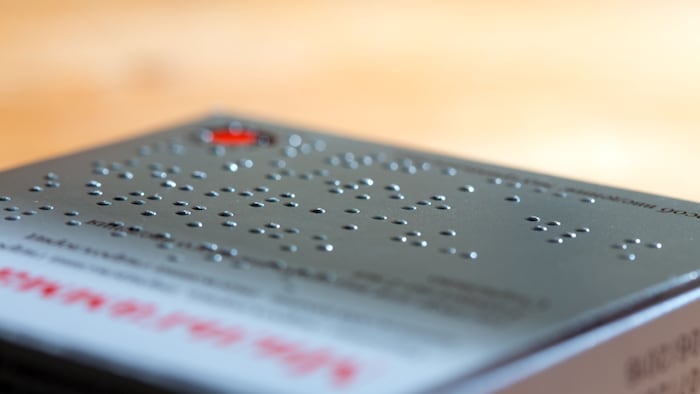
“Many” people with visual impairment have complained of pharmacists placing labels over braille on medication, the UK’s leading sight loss charity has said.
The Royal National Institute of Blind people (RNIB) told C+D that it hears from “many blind and partially sighted people” who struggle to identify their medicines when labels are placed over the braille on the packaging.
Read more: ‘Increasingly inconsistent’: Barcode issues impacting on secondary care provision
And Healthwatch this month highlighted the issue in a report on the challenges people with sight loss face accessing healthcare.
The NHS watchdog concluded that these patients are “still not reliably receiving accessible care”, and said pharmacies covering braille with labels was a theme that “emerged repeatedly” in feedback from patients.
“Serious consequences”
The RNIB estimates that approximately 1.9 million people in England live with significant sight loss.
The charity’s policy lead on accessibility Khadija Raza said pharmacists covering braille on medicine packets could have “serious consequences” for patients’ health if they are not able to follow the correct dosage.
She also noted that “for parents with sight loss, braille information on packets can also help them to safely and independently give medicines to their children”.
Read more: ‘Urgent need’ for pharmacists to support carers, says FIP
Raza stressed that “sight loss is a spectrum” and advised pharmacists to also provide information in “alternative formats” such as “large print, audio and electronically”, which may be more appropriate for a patient’s needs.
And she added that pharmacies should let patients know if they change the brand of medication provided, as “some people with sight loss rely on the colour or shape of the box, and size and colour of the tablet, to know what they are taking”.
Patient perspective
The RNIB highlighted feedback it had received in 2022 from a blind patient who was prescribed a course of new antibiotics by a GP without the dosage being explained.
They told the charity that the dispensing pharmacist later handed them the medication “without any explanation of the dose or time it should be taken”.
“I asked her about it, and she said that they had carefully colour-coded the medicine so I could tell which one was which, and handed me a sheet which apparently had large print details on it,” the patient said.
Read more: Morrisons pharmacist wins disability case against chain
“While this would have been helpful for people with some residual vision, I am completely blind and could not read it.”
They added that “no effort was made to ask me what my communication requirements were and how they could meet them”, and that they were left to “guess at which [doses] should be taken when”.
Read more: NHSE seeks ‘further evidence’ over ‘poor-quality’ medicines barcodes
The patient had “some knowledge of braille”, but said the braille on the packaging was covered so that they had to peel the label back to access it.
“The medicine made me feel dreadful, but I persisted as I knew how important it was not to stop antibiotics halfway through a course,” they said.
Read more: I didn’t need an eye injury to see the NHS is broken
“When I neared the end of the two-week intensive treatment, I noticed that for one medicine there were still quite a few tablets left. I realised that I’d only been taking one tablet when it should have been two each time.”
The patient’s GP then informed them that they would have to start the whole course from scratch, meaning they were on a “huge dose of antibiotics for a month, which was very stressful”.
“This kind of thing has happened on many occasions,” they said.
Read more: Patient death: ‘As a direct result of this dossette box case, I‘ve updated my SOP’
Community Pharmacy England director of legal Gordon Hockey told C+D it is “important that people with sight loss can access and identify their medicines safely by reading the braille information on medicine packaging”.
It comes after a report last month found that missing, incomplete or inaccurate barcodes are affecting pharmacy workflows in “more than half” of secondary care organisations.
And it follows the International Pharmacy Federation saying earlier this month that there is an “urgent need” for pharmacists to “recognise and support women and informal carers”.