
Refusing to dispense medicine to patients for financial reasons is justifiable in the current economic climate, according to the majority of responses to a C+D poll of community pharmacy.
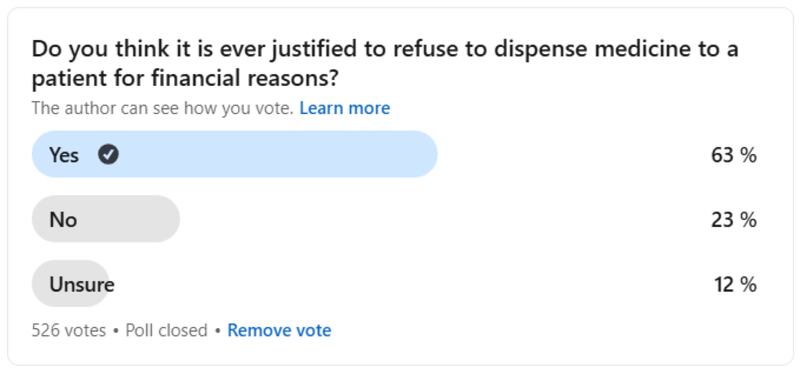
Over 500 respondents delivered a response to the question ‘Do you think it is ever justified to refuse to dispense medicine to a patient for financial reasons?’
Just 23% remained insistent that refusing to dispense was not justified for financial reasons.
However, 63% said yes, it was. And a further 12% were left unsure.
Though there are valid reasons any community pharmacy can decline to dispense medicine, such as an abusive patient, financial reasons are not among them.
And though dispensing at a loss has been a perennial bugbear for community pharmacy, the increasingly challenging cost of doing business – including the rising cost of medicines themselves – has exacerbated its impact.
Mitigate
But according to the department of health and social care (DH) the concessionary price and medicine margin arrangements “ensure” that pharmacists are “paid more” than they pay out for medicine.
Pharmacies have a “legal obligation to dispense all valid prescriptions presented to them, and they cannot decide not to because they are making a loss,” it said.
“Concessionary prices are in place to mitigate the losses for individual products, and medicine margin arrangements ensure that overall pharmacy contractors are paid more than the cost of their purchases.
“Community pharmacies are a vital front door to the NHS, which is why this government has provided them with the largest funding uplift of any part of the health service over the last two years.”
Unethical
But this stance was met with short shrift by pharmacists who chose to add comments under the C+D poll, with one suggesting the government might want to consider its own moral code.
“Notwithstanding the fact that directors have a legal responsibility to ensure the company does not systemise loss making, there is no reason that the DH cannot guarantee to pay its own drugs bill,” said one. “It is wholly unethical for any government to expect contractors to subsidise the NHS drugs bill.”
Another said: “Is this what Keir Starmer meant when he said that ‘those with the broadest shoulders should bear the heavier burden’. So you think we should bear the spiralling cost of medicines out of our pocket?”

A third respondent said: “Community pharmacy is in a very difficult position.
“Pharmacists absolutely have a professional and ethical duty to ensure patients receive their medicines, but community pharmacies are also independent businesses contracted to provide NHS services — not charities.
“No other sector is routinely expected to provide products or services at a financial loss indefinitely. Supermarkets would not be expected to sell groceries below cost as standard practice because it is unsustainable. The same principle applies to pharmacies.
“If pharmacies are continually forced to dispense at a loss, the long-term consequence is reduced staffing, reduced services, pharmacy closures, and ultimately poorer patient access to healthcare. This is even more important today as the population is ageing, patients are living longer with multiple conditions, and medication regimens are becoming increasingly complex.
“Community pharmacies are managing higher prescription volumes and greater clinical workload than ever before, all while under significant financial pressure. The real issue is not whether pharmacists want to dispense at a loss, but whether the funding model properly reflects the true cost of providing safe and sustainable pharmacy services.”
Almost impossible?
A different reader took a different angle, highlighting the role played by GPs.
“We are already dispensing at losses, and more GPs are refusing to switch to suitable alternatives because of the time it takes [as a result of] the number of switches that need making as a result of stock shortages.
“A simple solution will be to give pharmacies more power to use judgement. Why should we expect to dispense ramipril tablets at a loss when we can switch to capsule of same strength, if that’s cheaper, without having to waste a GP’s time to get it changed.
“We look silly to GPs when we ask for these, and we are smart enough to make this decisions ourselves. We can avoid these things if the NHS would allow pharmacies to make alterations to prescriptions like we did before with NCSO.
“Why do we have to wait for the end of the month, with fingers crossed, over whether we will be paid or make huge losses? We are busier trying to save GPs time, but no one seems to care about the time we are wasting sourcing medicines at sensible prices, which is almost impossible.”
Vocal
And another pointed to the unsustainability of the status quo – and that the Independent Pharmacy Association trade body had been particularly vocal on the issue in recent weeks.
“In the past there was enough fat on the bone to pay your wholesalers, pay your bills, pay your staff, pay your rates and pay your taxes,” they said.
“Over the last 30 years successive governments have driven down the price of drugs, removed legitimate payments for service provision, and decimated any possibilities of making a profit. And our organisations have just taken it. Thankfully they are now waking up to the fact that this cannot go on. IPA is leading the charge, but we need ALL pharmacies to stand up and be counted.”
IPA board member Ian Strachan said “over the past few weeks the IPA has brought to light one of the biggest concerns affecting pharmacy owners today, and that is dispensing at a loss.
“It is a story which not only resonates with patients across the UK but calls out one of the biggest injustices in society today - the lack of fairness and inequity facing one of the most compassionate professional groups in healthcare.”
Adapt to survive
Another respondent pointed to issues the NHS contract is causing across healthcare, rather than just community pharmacy.
“The NHS contract has become increasingly burdensome for many healthcare sectors, including dentistry,” they said.
“As a result, it’s understandable that some dentists have chosen to withdraw from it. The pharmacy sector might also benefit from reconsidering its involvement in the NHS contract.
“This could prompt a much-needed awareness of the challenges faced within the industry. With the oversaturation of pharmacies, the government may be hoping to see natural closures. This would allow them to reassess their options for the sector moving forward.
“Online pharmacies are poised to fill any gaps left by local closures, ensuring that patient needs continue to be met. The landscape of pharmacy services is certainly evolving, and adaptation is essential for survival.”
Finally, one respondent hit the nail squarely on the head, saying: “No other healthcare professionals work at a loss.”
The result comes in the wake of a fresh settlement to the Community Pharmacy Contract Funding deal for the year ahead.
