RPS museum manager Catherine Walker appeared on the ‘Throat Lozenges’ episode of the BBC’s Inside the Factory show on January 20.
She told the show’s historian Ruth Goodman about the ingredients commonly found in old medicines, and the impact the Bradford poisonings had on medicine regulation and safety.
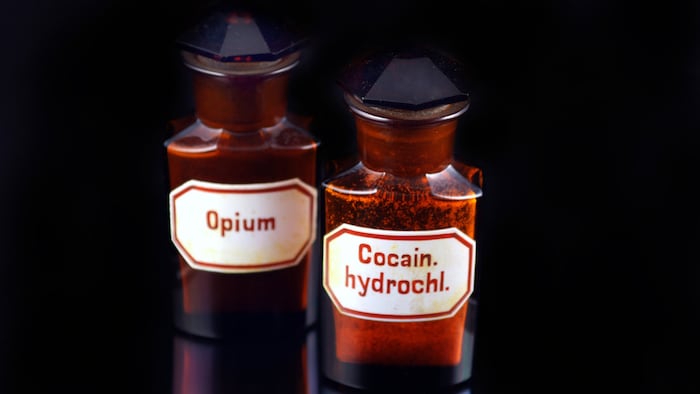
Opium and cocaine
The Victorian pharmacy in the episode is the model Gibson & Son chemist which is located in London’s Science Museum, and Walker explained how chemists sold food and wine as well as medicines.
“You could go for the opticians to get a tooth pulled,” Walker said. “It’s not like the NHS now where pharmacists are paid to supply you with prescription medicine.”
Read more: ‘Remarkable history’: Museum secures Georgian manuscript
Walker showed an illustration from the 1860s depicting a girl asking for laudanum, a mixture of opium and alcohol, reinforcing how little restrictions there were on what chemists and druggists could sell.
“You can see from her sunken cheeks that this is a depiction of somebody who’s already addicted. Children were quite often given laudanum as a soothing aid to help them sleep,” said Walker.
Read more: The Boots employee for 50 years who helped produce ibuprofen
Chemists made highly addictive products such as throat pastels containing diamorphine and cocaine, with the former acting as a cough suppressant and the latter as an anaesthetic to soothe the throat.
Bradford poisonings
Chemists also readily sold poisons like arsenic, strychnine and cyanide over the counter, and Walker showed Goodman a copy of the 1858 Bradford Observer newspaper which depicted the Bradford poisonings - where selling such items went wrong.
“There was a confectioner who was making peppermint humbugs, and he was padding out the sugar because it was so expensive with a plaster of Paris mixture,” said Walker.
Read more: Pharmacy in the 17th century: a look inside an apothecary’s shop
“And so, he went to his chemist and druggist to get some but he was accidentally given arsenic, and he mixed those into the sweets.”
The sweets were sold at a discount because they didn’t look quite right, but more than 200 people were poisoned and at least 20 died.
Read more: Exploring pharmacy museums around the world
“You can imagine the panic, people literally running through the streets warning people.”
This poisoning led to the Pharmacy Act of 1868 that limited the sales of poisons to qualified pharmacists and druggists.
Read more: ‘Oldest pharmacy in world’ opens in Harrods
“So, instead of anybody being able to set up a chemist shop, it had to be highly regulated. In order to practice pharmacy, you had to be a member of the Royal Pharmaceutical Society.
“It’s regulations like this that help build the public trust in pharmacy we have today,” said Walker.
Read more: ‘I won’t miss the dusting!’ Pharmacy artefacts sold for thousands of pounds
The rest of the episode sees the show’s presenter Paddy McGuinness visit the Reckitt medicine factory in Nottingham as he follows the production line of Strepsils lozenges and Nurofen ibuprofen tablets.
The show ends with a segment on ibuprofen, which was created by Boots in 1969.
C+D spoke to one of its 50-year employees in September about his role in the early days of ibuprofen production.