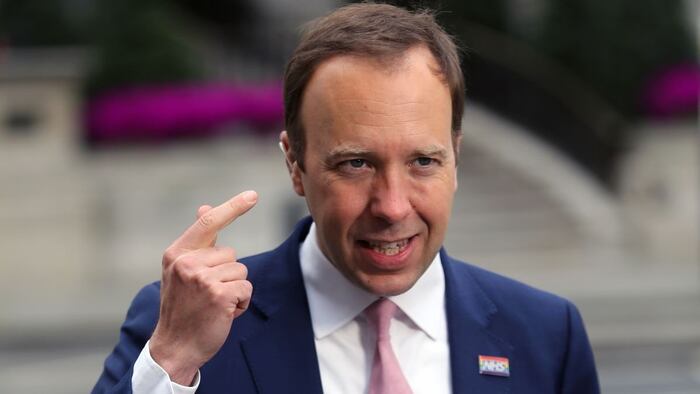
Former health secretary Matt Hancock has claimed the NHS England’s (NHSE) senior management team have “a lack of enthusiasm for giving more to community pharmacists than they absolutely have to” at the latest Covid-19 Inquiry hearing last week (November 21).
In a response to the inquiry’s question about the life assurance scheme introduced in April 2020, Hancock said in order to “maximise taxpayer value for money, NHS England is, by tradition, really very tight on pharmacists” and this is “inbuilt” into NHSE.
Read more: Xrayser: The COVID-19 life assurance lacks rational compassion
He added NHSE’s attitude to community pharmacy is “borne of the fact that their main relationship is a contractual negotiation”.
Questioned on why community pharmacy wasn’t included in a pandemic-related life assurance scheme, which was implemented to offer families of “eligible” frontline health and care staff in England who died from the virus a £60,000 payout, Hancock warned his evidence would be a “brutally honest answer to this with some trepidation”.
“Last thing on the list”
Previously submitted evidence showed Hancock called for “all pharmacy staff to be included” in an email sent on April 11, 2020, but the announcement on April 27 only included pharmacies in a hospital or GP setting.
C+D wrote to Hancock two days after the initial life assurance announcement calling community pharmacy’s exclusion “nothing short of a national disgrace”.
The same day, C+D launched a petition for pharmacy workers to receive the same life assurance scheme which gathered nearly 10,500 signatures.
Read more: COVID-19 inquiry apologises for pharmacies not getting the ‘recognition’ they deserved
The inquiry noted the exclusion was because this decision was not agreed to by the Treasury and was “nothing to do with NHS England”.
But Hancock said it “will have been the last thing on the list, I would have thought, from an NHS England point of view”.
Evidence from the National Pharmacy Association (NPA) at the inquiry said the “three-day wait” for the decision to be reversed was “demoralising” and “demotivating”.
Read more: ‘Community pharmacy should be front-and-centre during the COVID-19 inquiry’
The inquiry further questioned Hancock on whether he felt community pharmacy was “treated as an afterthought” during this issue.
“Not as far as I was concerned,” he replied. “But they evidently were as far as the system was concerned because of how that announcement came out.
“They were absolutely top of my mind. But I couldn’t necessarily drive that through the system.
Read more: NHSE pandemic plan reveals pharmacy vaccination role and antibiotic stockpile
“The system was not looking after community pharmacists enough. That was my feeling too. And hence I changed it as soon as I could,” Hancock said.
He added that this “sort of problem is meat and drink in Whitehall, it happens all the time” and “it’s just part of the daily life of an active minister that you have to go and fix problems all the time and then take accountability for the system as a whole”.
“Scandalous” treatment
Last week (November 22), responding to Hancock’s comments, NPA chief executive Paul Rees said it is “scandalous that community pharmacies are treated as second class citizens within the healthcare system”.
“That attitude was evident during the pandemic and is still playing out today in the form of chronic under-funding.
“The consequences are clear for all to see in terms of pharmacy closures and poor morale in the sector.
Read more: Free PPE for pharmacy teams extended until March 2024 or stocks run out
“Government and NHS England need to fix the immediate financial crisis and recast community pharmacy in their minds, as a valuable partner in fixing long-standing NHS challenges, not as a cost centre,” Rees said.
Community Pharmacy England (CPE) chief executive Janet Morrison said “during the COVID-19 pandemic community pharmacies were the only healthcare locations that kept their doors wide open to the public”.
“This made it all the more unfair that pharmacies were initially overlooked for critical support early on in the pandemic,” she added.
The Independent Pharmacies Association (IPA) cheif executive Dr Leyla Hannbeck said it’s “devastating to hear a former Health Secretary say he wanted to back community pharmacies in the NHS’s hour of need, only to be blocked by the system”.
Read more: Death assurance policy reversal: community pharmacists to be included
“This is yet more damning evidence of the systematic underestimation of community pharmacies. And it’s repeating itself today, where other areas of primary care have new funding deals and pharmacy has been left behind.
“We urge the new Government to work with us. We cannot afford to overlook the essential role of community pharmacies in building a resilient, accessible healthcare system any longer,” Hannbeck said.
She added “a new approach to shape the NHS 10-year plan“ is needed as “one of the key lessons from the pandemic must be to make better use of pharmacies”.
Lower priority
Hancock also confirmed that community pharmacists were “lower in the priority for people that needed access to the personal protective equipment (PPE) portal” due to limited supplies available.
PPE, such as FFP3 masks, was not available to community pharmacists and they couldn’t access the PPE portal until August 2020, as Hancock revealed there was a “hierarchy” of where PPE was allocated to.
“You’ve got to remember that pharmacists are private businesses and outside of the pandemic, of course they buy their own protective equipment in the same way that most social care providers are private businesses, and before the pandemic they [would] buy their own equipment.
Read more: Xrayser: PPE makes pharmacy staff look like extras in a sci-fi film
“The government was not the only provider of PPE in this situation. So there’s a balance to be struck between who the state provides for and, also how, given we have limited access, that is then distributed.
“I wanted it to be available to pharmacists,” Hancock said.
A National Audit Office (NAO) report published in November 2020 found that only 0.04% (one million) of PPE items distributed via the parallel supply chain between March 20 and July 31 of that year were directed to pharmacies via wholesalers.