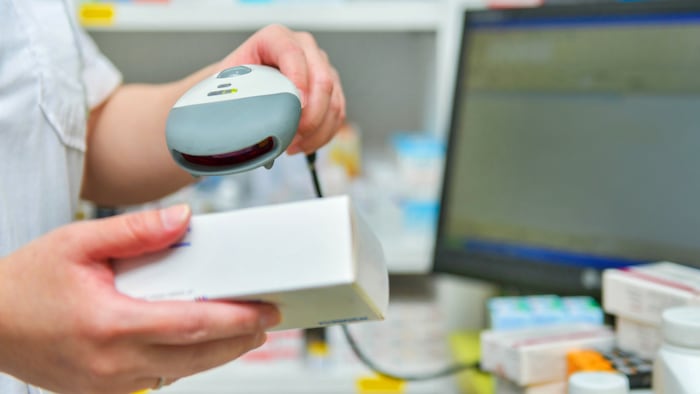
NHS England’s call for mandatory 2D barcodes on UK medicines packaging, and to include Global Trade Item Numbers (GTINs) information in the licensing process for medicines, has been backed by the RPS.
It has also recommended that manufacturers and market authorisation include 2D barcodes “voluntarily” and implement “contingency plans for managing medicines packs without barcodes”, including manual verification or expiry checks .
And it called for pharmacists to continue reporting recycled GTINs or lack of 2D barcodes to “build the evidence for the need for change”.
Read more: Barcode accuracy must be treated as a patient safety issue
It comes five months after a parliamentary petition was launched to make GTIN barcodes mandatory to “protect patient safety”.
In June, the UK’s four chief pharmaceutical officers wrote to the UK’s pharmaceutical companies about “continuing to print 2D barcodes on medicines’ packaging, encoding, as a minimum, the GTIN, batch number and expiry date”.
Read more: MHRA issues alert after pharmacy robot spots drug barcode error
The MHRA’s head of defective medicines Himal Makwana said that “barcode integrity is central to safety and efficiency” and a “matter of patient trust”.
“Every unreadable or incorrect barcode risks breaking the chain of safety that patients and healthcare providers are now dependent upon,” they added.
Concerns
The RPS said its members had raised concerns of 2D barcodes no longer being printed on all medicines that enter the UK supply chain, as well as “no assurance or process that verifies that the information on the barcode is accurate”.
The European Union’s (EU) Falsified Medicines Directive (FMD) mandated GTINs in 2D barcodes but since the end of 2020, this no longer applies in Great Britain because the UK left the EU.
Losing this safety feature has removed the ability to automatically check a product’s “critical data such as LOT and EXPIRY with a simple scan”.
Read more: MHRA busts second illicit weight loss jab manufacturing facility
No legislation or policy for a UK authentication system linked to Europe has been proposed by the government since.
Since the Windsor Framework was implemented in January 2025, the inclusion of a 2D barcode on medicine packaging has been optional, which has led to “a growing number of packs” without 2D barcodes that undermines “key safety and operational processes”.
Issues
The RPS said barcode standards are “fundamental to patient safety, operational resilience, and the NHS digital future”.
It said barcode errors, duplication or absences can lead to a patient receiving the wrong medicine or dose and lead to medicines defect notifications.
In October, the Medicines and Healthcare products Regulatory Agency (MHRA) reported a pharmacy using robotics reported duplicate GTINs being used on some drugs manufactured by Relonchem Ltd that sparked a medicines defect notification.
Read more: Do not ‘risk health’ by buying illegal meds online, urges MHRA
The RPS said a lack of 2D barcodes will disrupt robotic dispensing and supply and force pharmacy teams to do “manual workarounds” that increases workload and negates automation.
It said that the lack of barcodes and GTINs on medicines undermines “NHS ambitions for Scan4Safety and closed-loop medicines management (CLMM)”.
And there’s an operational risk for pharmacies in dispensing expired or incorrect medicines because of no GTINs, and this can lead to “slower and less effective product recalls”.
Read more: MHRA seized £45m in illegally traded drugs in 2025
The RPS added that NHS systems such as dm+d and EPMA/EPR rely on accurate GTINs for interoperability, but they are not part of the licensing process so the data is inconsistent and “often incorrect”.
In October, PillSorted superintendent pharmacist Zeinab Ardeshir wrote for C+D about the consequences of inaccurate barcodes for the sector.