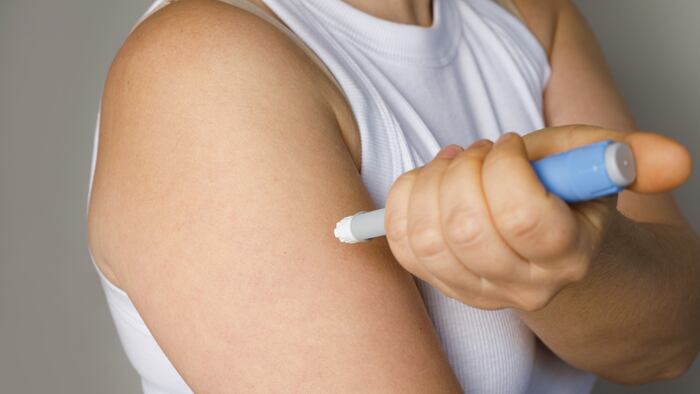
Health officials are set to announce plans to make weight loss injections available “on prescription” at pharmacies through “a short over-the-counter consultation” without seeing a doctor, the Mail Online today (May 2) reported.
The newspaper said that it understands “a deal worth tens of millions of pounds will be struck with a major pharmaceutical firm to fund a pilot scheme across the UK”, which would make the jabs more widely available “on the NHS”.
“Once the deal is signed, it will be possible to walk into a pharmacy and, after a short assessment, leave with a supply of jabs for £9.90” – the current cost of an NHS prescription - it added.
Read more: Mounjaro: NICE sets out £317m annual NHS weight loss jab rollout
The Mail said the deal is part of ministers’ plans to expand the use of weight loss injections by offering “creative” prescription sources “such as through high street chemists, health centres and apps”.
In a joint statement, the Department of Health and Social Care (DH) and the Department for Science, Innovation and Technology (DSIT) today told C+D that they would be “looking across the board at how these drugs can be made available to more people who can benefit from them”.
Both added that the reports are speculative.
Pharmacies involved “from the beginning”
It remains unclear whether the drugs would be provided via patient group direction (PGD), prescription or as over-the-counter (OTC) medicines.
A source said that “people with resources are already buying [weight loss drugs] privately”, the Daily Mail reported.
“But we know there are people from certain backgrounds who always miss out on this kind of support,” the source added.
Read more: Pfizer scraps second attempt at weight loss pill
“This [pilot] makes sure that local pharmacies and trusted medical support organisations are involved in the rollout from the very beginning,” they told the newspaper.
Meanwhile, the Telegraph today reported that “a health source said that pharmacies would be key to rolling out [weight loss] jabs on a mass scale”.
Read more: Newspaper rapped over article promoting Mounjaro
“The DSIT is expected to announce plans to try new ways to prescribe and monitor use of the medication,” the newspaper added.
Mounjaro manufacturer Eli Lilly today told C+D that it “has ongoing dialogue with the government about the opportunities to improve obesity care in the UK”.
And Wegovy manufacturer Novo Nordisk told C+D that it welcomes “initiatives that improve access to obesity treatments for those who need them most”.
“Free” jabs a possibility
Commenting on the reports, new National Pharmacy Association (NPA) chair Olivier Picard said that “access to medicines that could cut damaging levels of obesity shouldn’t be restricted to those who can pay or disadvantage deprived communities”.
“We’re yet to see the detail but this announcement has the potential to make sure that people who need these treatments the most could access them for free,” he added.
Read more: Pharmacies must ‘immediately’ remove weight-loss ads, regulators warn
“Pharmacists are experts in medication and many have extensive experience delivering weight loss injections as part of a package of care including lifestyle advice,” he said.
“They are best placed to help roll this treatment out on the NHS, with the right funding support,” he added.
NHS rollout
The reports come after the National Institute for Health and Care Excellence (NICE) recommended in December that Mounjaro be offered on the NHS “alongside a reduced-calorie diet and increased physical activity” to people with a body mass index (BMI) of more than 35 and “at least one weight-related illness”.
The draft guidance revealed that the “first” NHS Mounjaro patients of a possible 3.4 million in England were set to receive the weight loss jab by March 2025.
With weekly injections priced at £122 for the maximum dose, it estimated at the time that the drug would cost NHS England (NHSE) around £317.2 million per year by the third year of implementation.
Read more: Wegovy: DH to consider pharmacy role in £40m two-year obesity pilot
NICE recommended Wegovy for adults with a BMI of a minimum of 35 and one weight-related health condition such as diabetes or hypertension in March 2023, while the DH announced it would launch a £40-million two-year obesity pilot that could see pharmacies dispense the drug in June that year.
At the time, NICE advised that Wegovy should only be available via specialist weight management services, which are largely hospital based, meaning that “only around 35,000 people would have access” to it “when tens of thousands more could be eligible”, the DH said.
Read more: Weight loss: Online pharmacy influencer discount codes shot down
Meanwhile, weight loss jabs are widely available privately from bricks-and-mortar and online pharmacies.
Last month, the pharmacy, medicine and advertising regulators joined forces to warn pharmacies not to advertise weight loss drugs via social media.
“Prescription-only medicines (POMs) cannot be advertised to the public” – “therefore, you must not promote products such as Ozempic, Wegovy or Mounjaro”, the notice stressed.
Read more: Revealed: Pharmacy weight loss consultations rocket twenty-fold
“No-one operating in this industry can say they have not been warned,” it added.
In February, the General Pharmaceutical Council (GPhC) announced new rules stating that online pharmacies “cannot” prescribe based on online questionnaires alone and must “independently verify” patients’ weight and height before prescribing weight loss drugs.
A month on, C+D revealed that the regulator had already received almost 50 concerns relating to weight management.
