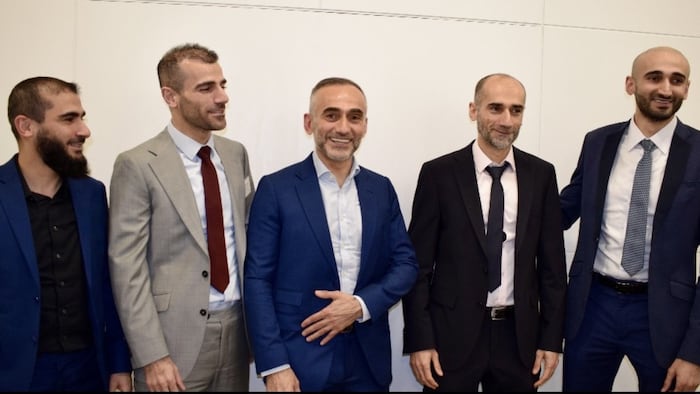
Optimistic, composed, and seemingly unruffled by the prospect of getting 129 failed pharmacies back open, the five brothers who run Allied Pharmacies sound quietly confident.
It’s noticeable considering until three years ago, they owned only 43 pharmacies. Now they own 300.
Allied grew steadily at first, opening two sites in 2008 in Oldham and Nottingham.
But after buying 100 Lloyds branches when it exited the market, Allied’s chief executive Suhaib Abdullah (and the eldest brother at 51) says that’s when everything “jumped”.
“It was a challenge to get a team to expand and cope with the workload,” he says. But by the time the Jhoots portfolio came to market, “the timing was the right time”.
“A few weeks before Jhoots came to market, we were thinking ‘we’ve fixed everything and got such a strong team, the team are a little bit bored’. So, we thought we can do this.
Read more: Inside the deal for Allied and Jhoots Pharmacy
“With both Lloyds and Jhoots, it was ‘there’s an opportunity, is it the right time for us? Do we have the funding? Will it stress our operation, our cash flow?’ If everything’s okay, let’s go for it.
“We’ve done contracts and acquisitions; there isn’t anything new here. The numbers we can more than cope with. It was a unanimous thing, we all agreed it was an opportunity to expand.”
Never closed
Following an interview with Abdullah in November, after Allied acquired the first lot of Jhoots branches, he told C+D one of the reasons they bought the branches on was “to improve” its own reputation “as a company” and “as a pharmacy”.
Reputation is something that pops up frequently with the five brothers, who have an HQ in St Helens on Merseyside, but were visiting MPs last week at Westminster. In the shadow of the towering Big Ben, there is a desire from the brothers to prove that they can try their tested business model on a much bigger scale.
“We’ve done contracts and acquisitions; there isn’t anything new here.”
Abdullah says they “started from the ground up and slowly expanded” through opening pharmacies on new contracts granted from the NHS.
“So, it was slow initially and gradual. Because of the way we operated, it is very difficult to increase your numbers with a new contract because we have to run that pharmacy for two or three years to get it where we want it.”
Read more: Jhoots Pharmacy owed creditors at least £11m, filings reveal
One of the ways to do that effectively is through offering up to 50% shares in pharmacies as part in a joint venture with a pharmacist.
“Half of our pharmacies are partly-owned by the pharmacist running it. This way the pharmacist concentrates on providing the pharmaceutical services and we run the back end of the business side.”
Read more: IN FULL: Jhoots pharmacy owner announces immediate rebrand
It’s with this proof of concept that Abdullah proudly shares “we’ve never closed a pharmacy”.
But with Allied taking on 129 pharmacies, and some at risk of losing their contracts after being closed, is this likely to continue?

Monthly losses
Abdullah’s response is confident. “We will not close any of these pharmacies, so have confidence to come in and use us. We’re not going anywhere.”
There are some practical realities to opening them, though. Managing director Suhail Sharief says that by April “at least 80% of the branches will be open”.
Read more: REVEALED: Allied takes over 68 more Jhoots pharmacies
As for the remainder, it’s “simply because we’re not allowed to go in. The landlord has terminated the lease and we’re negotiating the lease.”
Chief commercial officer Mussab Sharief says they’ve opened at least 50 branches so far, after opening 33 within the first month. But each one is losing £10k a month, running at a loss for now, in the hope of them becoming sustainable again.
Kinnock
It’s a consequence of purchasing closed pharmacies that have had their reputation and finances hit.
In November, pharmacy minister Stephen Kinnock revealed integrated care boards (ICBs) across the country were working to strip “over 20” Jhoots pharmacies of their NHS contracts after ICBs had already issued “almost 1,300 remedial and breach notices to Jhoots stores” aiming to “stop repeat violations”.
Read more: Allied takeover: Which ex-Jhoots branches have reopened so far?
Skirting past questioning over whether they think Allied overpaid for 129 branches facing such serious issues, Abdullah says the priority for each pharmacy was “making this a profitable branch”.
“When we went into this, the issue really wasn’t the initial payment. Quite a few of these were coming towards a deadline of losing the contract.
“But our reputation is very good with the NHS, even before Jhoots, so a lot of these had pauses put on withdrawing the contracts. We moved so quickly.”

Consolidation
Abdullah insists that closing any of the Jhoots branches “is not on the table” but also caveats “unless it’s a consolidation”.
As an example, he says they have taken on two Jhoots branches close to each other, with a competitor pharmacy nearby.
“Opening both of them is not good for us, or for the NHS, so we would combine those. Wherever there’s an opportunity for consolidation, we’re very active.”
“Nowadays, you’re looking at 8,000 to 10,000 items to start making money, usually.”
It’s an approach they have used previously to manage the “lower end” pharmacies that don’t dispense many items per month, having completed 30 since they started back in 2008.
“If there’s a pharmacy doing 3,000 items, its loss-making. Nowadays, you’re looking at 8,000 to 10,000 items to start making money, usually. We would approach the closest pharmacy, and we would offer an opportunity to work together.
Read more: Exclusive: Allied went into Jhoots deal ‘blind’, says CEO
“We either buy them out, or they buy us out, or we go into partnership. Most of the time, we tend to reach a deal. This way, instead of having two next to each other struggling, either us or them or jointly, we would operate one pharmacy that can survive.
“This way everyone’s a winner. There’s one less pharmacy in terms of NHS funding. There’s no issue with a service provision.”
Extortionate
C+D previously reported on Allied pressing on with a consolidation after a GP landlord had locked them out of one of its premises in Exeter following months of negotiations over “extortionate” rental costs.
But Abdullah says from the branches it’s opened so far, it can see “more people are using” the pharmacies.
“Every week, items are going up. We knew it would be faster than a new contract because with those, people don’t know there is a pharmacy there, we need to do marketing. But it has been slower than we expected.”
Locums
Allied has taken on additional staff in the Jhoots takeover deal. Those who have TUPE’d over (employees transferred from Jhoots to Allied) and not left Jhoots are in line to receive backdated pay.
In November, Allied had paid 35 staff members outstanding wages and said those affected who contact Allied Pharmacies will have their unpaid wages settled the “same day”.
Read more: Exclusive: Unpaid Jhoots locum fees surpass £1m
Abdullah says they’ve encouraged those who have left to come back and if “the ones that have left have wages to be paid, they can get that through the insolvency company”.
C+D revealed in November that 109 of the Pharmacists’ Defence Association’s (PDA) locum members are owed a combined total of £1.1m after working at Jhoots pharmacy branches.
“Say you were taking on an operating pharmacy, maybe there is a way to see who else we can compensate.”
All five brothers have worked as locums and understand how integral they were to keep some of the Jhoots branches open.
Managing director Sharief says there’s “massive sympathy” for those who “had worked for months and are owed a significant amount of money”, and Abdullah encourages them to claim through the administrators.
Read more: Jhoots: Allied to settle unpaid staff wages ‘in full’ amid takeover
“Part of the whole deal, and the priority for us, is how do we open every single one and run this on a loss until it becomes viable? There’s a lot of pressures there.
“The administrators said, ‘what you’re buying is a contract and some may expire’. It is a risk. Say you were taking on an operating pharmacy, maybe there is a way to see who else we can compensate.”
Read more: Revealed: Everything we know about action against Jhoots
The queue is not exclusive to locums, with banks, wholesalers and landlords all required to get what they are owed through the insolvency company.
Some 22 businesses trading as Jhoots Pharmacy - which come under the company name SNJ Health - debts exceeding £11m owed to 170 creditors when they entered administration in November.
A further 15 businesses grouped under Jhoots Pharmacy Limited went into administration last month with debts of £19.6m.

Strategy
Allied Pharmacies accounts certainly look healthier, with turnover reaching £128m in 2025, more than triple the amount three years before.
Pre-tax profits hit £1m, up from a £1m pre-tax loss in 2024, but still short of the £4.7m it posted in 2022.
“You’re ready for any issues in the future, whether that’s regulatory change or Amazon coming to the market or privatising”
Now settled in with their new branches, Abdullah says Allied plans to continue “what our strategy was before we bought the Lloyds and Jhoots. It’s to strengthen each pharmacy. Is there a possibility of consolidation with a pharmacy next door?
“Another is the lower item pharmacies. Can a local pharmacist buy a share? Anything below 10,000 items per month, we look at it if there is anything we can do because in the long run, we don’t want anything below that.
Read more: DH working to ‘resolve’ Jhoots situation ‘as quickly as possible’
“When we started, 2,500 items would break even but now it’s 7,000. Anything below 10,000 items per month is a potential consolidation.”
He explains working to the 10,000 item per month target is so “you’re ready for any issues in the future, whether that’s regulatory change or Amazon coming to the market or privatising”.
Funding
During their London visit, where the five brothers spoke to over a dozen MPs, including from the APPG and MPs whose constituencies were impacted by Jhoots, the brothers stressed closures will continue if funding isn’t sorted out.
“If there is only a small pot, is there a possibility to save the village or remote pharmacies?” says Abdullah.
“Making the lower item pharmacies work requires a lot of hard work. Our pledge is we won’t close the ones we’re in charge of because we’re pragmatic and make deals with local pharmacists and competitors.”
Read more: Revealed: The 60 Jhoots locations taken over by Allied Pharmacies
He says the failure of Jhoots was partly caused by funding.
“When we spoke to Stephen Kinnock, he was saying ‘it was an operator management thing, and we need regulation’ and he didn’t mention anything else.
“We said, ‘it’s one of the pieces of the puzzle causing this, but there’s also funding’.”
“This is why we were speaking to MPs to say if there isn’t an uplift on funding, we will have closures.”
Read more: BREAKING: Allied Pharmacies takes over 60 Jhoots branches
He’s adamant he won’t close any of the Jhoots branches Allied has taken over. But Abdullah says the number of pharmacies it owns will “definitely change after a year or two” through selling shares to pharmacists.
“We would like to be one of the strongest in the market,” he says. “We’re all pharmacists and have done it from the ground up. We’re fortunate, lucky, but we work very hard. And now the immediate thing is, we have this project to fix.”